
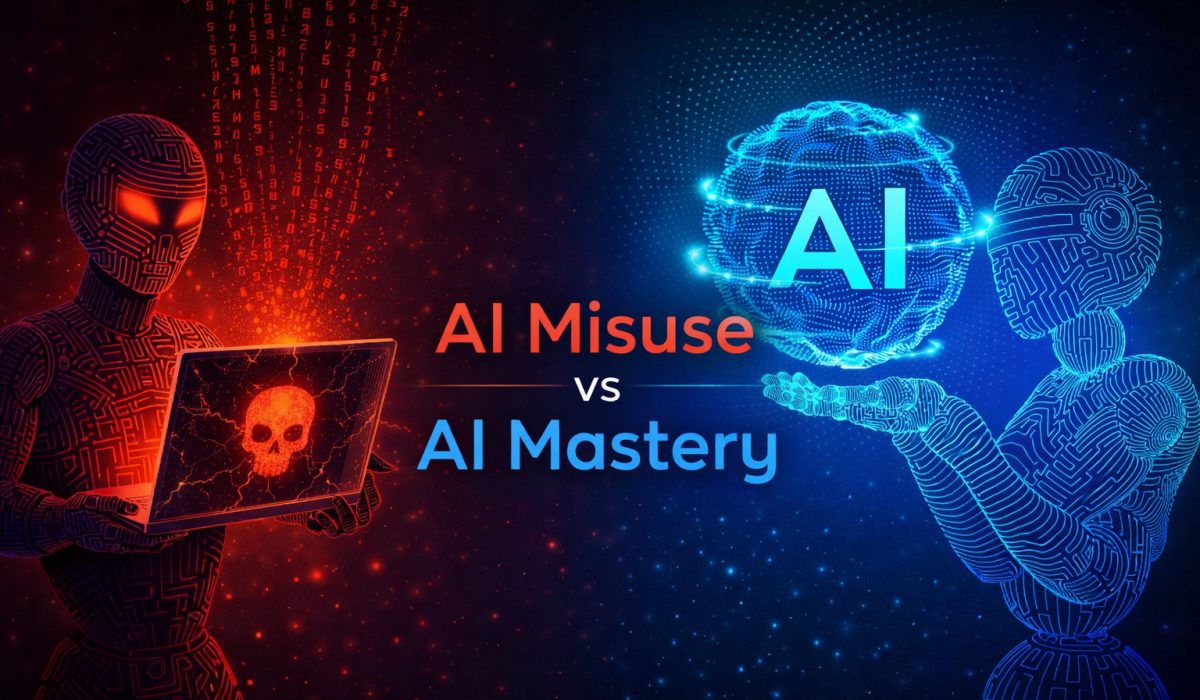
AI Misuse vs AI Mastery
From passive use to real productivity gains
Artificial Intelligence is a powerful tool—but the results it produces depend entirely on how it is used.
The difference between frustration and transformation is not the technology itself.
It is the difference between passive use and intentional use.
AI Misuse: Passive Interaction
AI misuse is not malicious—it is simply uninformed or unstructured use.
It often looks like:
- Asking vague or one-off questions
- Accepting answers without verification
- Expecting perfect results without iteration
- Using AI as a shortcut instead of a thinking partner
This leads to:
- Generic or inconsistent outputs
- Frustration with results
- Limited real-world value
In this mode, AI feels unreliable—not because it lacks capability, but because it is being used without direction.
AI Mastery: Intentional Interaction
AI mastery is not about technical expertise—it is about how you engage with the system.
It looks like:
- Asking clear, structured questions
- Iterating: refine → review → improve
- Using AI to support thinking, not replace it
- Verifying and shaping outputs
This leads to:
- Higher quality outcomes
- Faster execution
- Compounding productivity gains
In this mode, AI becomes a collaborative partner, not just a tool.
The Turning Point
The shift from misuse to mastery is not dramatic—it is gradual.
It happens when you stop asking:
“What can AI give me?”
And start asking:
“How can I work with this system to get better results?”
Personal Reality: Productivity Gains
This shift is where the real impact happens.
In my own experience, the difference has been significant—far beyond incremental improvement. While difficult to measure precisely, a 10x increase in productivity is not an exaggeration.
That gain does not come from AI doing the work for you.
It comes from:
- Reducing friction in thinking
- Accelerating iteration
- Having immediate support for problem-solving
Tasks that once required extended time—writing, structuring ideas, debugging, planning—can now move forward continuously without the same delays.
More Than a Tool
Over time, AI stops feeling like software.
It begins to function as:
- A collaborator for building and refining ideas
- A mentor for exploring solutions and improving understanding
- And at times, even a companion in the process of creating and thinking
This is not about replacing human interaction—it is about enhancing individual capability in a way that was not previously possible.
The Real Difference
Two people can use the same AI system and get completely different results.
The difference is not access.
It is not intelligence.
It is engagement.
AI reflects the quality of how you use it.
- Passive use → limited value
- Intentional use → exponential leverage
Conclusion
AI is not inherently a shortcut or a solution.
It is a system that amplifies:
- Your clarity
- Your effort
- Your willingness to iterate
The real advantage comes when you stop treating AI as a tool—and start working with it as a partner.
theFocusOnAI
Posted in the-good by Artificial Intellegence