
Forks #1
There are moments in life when the road does not gently curve, but suddenly splits.
I was eight years old when I came to my first fork.
Before that, life had a quiet sense of order. We had just moved into a new home in Oakmont Woods in Glendale. Ours was the first family in the subdivision. For a short time, even the electricity had not yet arrived, and we relied on a gas generator. I remember its steady hum as part of those early days.
To me, it felt like we were pioneers.
The hills were covered with oak trees, and as more families moved in, the empty streets filled with children. My first best friend, Terry, and I spent our days riding bikes, playing baseball and football in the street, and exploring the hills as if they belonged to us.
It was, in every way that matters to a child, a good life.
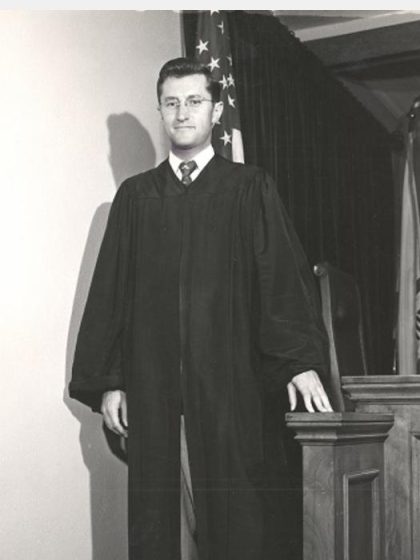
My father stood at the center of that world in a quiet, steady way. He was a judge on the Los Angeles Superior Court, appointed at a young age by Governor Earl Warren, and later elevated to the Appellate Division. I did not fully understand what that meant. I only knew that he was respected, thoughtful, and moving forward in a life that seemed full of promise.
Every Saturday after church, we visited my grandparents. My father, the son of a Seventh Day Adventist minister, held deep respect for his parents. Those afternoons had their own rhythm—simple meals like lentil soup and toasted English muffins with melted cheese and a slice of tomato. My grandmother’s warmth filled the room. My sister and I would often leave with a few coins, enough for candy and small treasures at Duncan’s.
Life had structure, but it was gentle. There were expectations, but also kindness. There was room to grow.
And then, without warning, everything changed.
My father became ill with pneumonia. Within a week, he was gone.
I remember the night my mother woke me. Some moments never leave you. The room was dark. Her voice was soft, but different—carrying something I had never heard before.
She told me my father had died.
There is no way for an eight-year-old to understand that moment. Only a feeling—sudden and overwhelming—that something essential has been taken away, and will not return.
The funeral followed on a rainy Southern California day at Forest Lawn. I remember the gray sky, the quiet voices, and what seemed like hundreds of people. Faces I did not know. A sense that my father had been part of a much larger world than the one I understood.
That was the fork.
The Road I Took
After that, life continued—but it was no longer the same.
Outwardly, things looked unchanged. I went to school, played in the same neighborhood, and lived in the same home.
But inwardly, something shifted.
I became quiet. Careful. At school, I carried something I could not explain. I lived with a quiet fear that someone might ask me about my father. A simple question could undo me. The loss was always just beneath the surface, and when it rose, it came as tears I could not control.
So, without knowing it, I learned to protect myself.
I stayed small. Watchful. Sensitive.
It was not a choice.
It was the path.
The Other Road
But there is another version of that life.
In that life, my father does not die.
He recovers. He comes home. Life continues—not untouched, but unbroken.
In that version, I grow up with his presence shaping the years that follow.
I imagine him in the everyday moments—standing quietly at the edge of a baseball game, offering a few thoughtful words. Sitting at the dinner table, asking questions that made me think. Guiding without forcing.
I imagine going to school without the weight I carried. Without the fear of being undone by a simple question. Perhaps I am more confident. More willing to speak. Less guarded.
As I grow older, I imagine turning to him—not for answers, but for perspective. A man trained to weigh decisions, to see both sides, to understand consequences. What would that have meant to a son trying to find his way?
Would I have been different?
There is no way to know.
But I believe this: his presence would have changed the texture of my life. There would have been a steadiness where there was uncertainty. A quiet confidence where there was hesitation.
Not a better life.
But a different one.
Looking Back at the Fork
At eight years old, I did not choose that fork.
It was given to me.
And yet, it shaped me in ways I could not have understood then.
The sensitivity I once saw as a burden became a way of understanding others. The quietness became reflection. The experience of loss became, over time, an awareness of what truly matters.
We do not get to choose all the roads we walk.
Some are chosen for us.
But in the end, we become the person who walks them.
That was my first fork.
Posted in forks by Geoff Stevens