
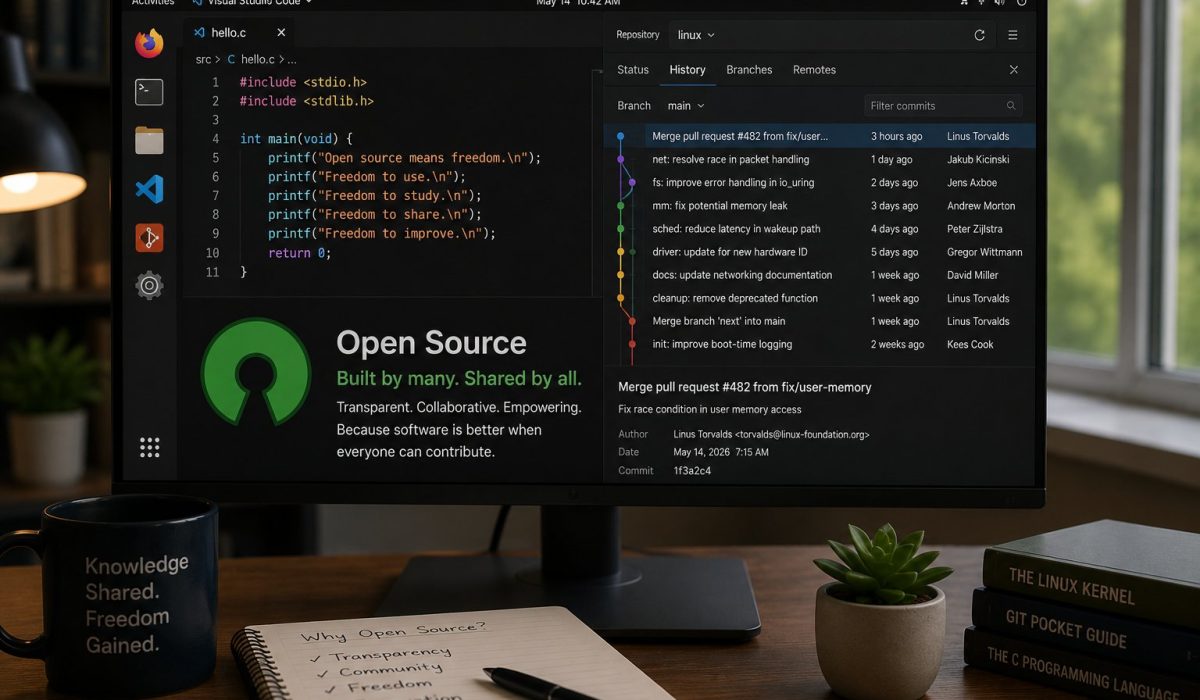
The Power of Open Source
For most of my time using computers, I didn’t think much about how the software I used was built.
It worked. That was enough.
Operating systems, applications, updates—these were just part of the background. I used them without really considering what was underneath.
But as I started looking more closely at the systems I rely on every day, one idea kept coming up:
open source.
It wasn’t a new concept. I had heard the term before.
But I had never really thought about what it meant in practice.
What open source actually is
At a basic level, open source means that the code behind a piece of software is available.
Not just visible—but open to inspection, modification, and improvement.
Anyone can look at it.
Anyone can contribute to it.
It’s not controlled by a single company in the same way traditional software is.
That sounds technical.
But the impact isn’t just technical.
What that changes
The more I thought about it, the more I realized that open source changes the relationship between the user and the system.
With most software, you’re working within something that’s been built for you.
You use it as it is.
With open source, there’s a different idea underneath:
That the system is not just something you use—
it’s something that can be understood.
And if needed, changed.
Transparency
One of the first things that stands out is transparency.
When the code is open, there are fewer unknowns.
There’s less of a sense that things are happening behind the scenes without your awareness.
That doesn’t mean everyone reads the code.
But it does mean that someone can.
And that changes the level of trust.
Control (or at least the possibility of it)
In my earlier experience with computers, systems felt more contained.
Purpose-built. Understandable.
Over time, that changed.
Modern systems are more powerful—but also more abstracted.
More decisions are made for you.
Open source doesn’t automatically give you control.
But it gives you the option of control.
And even knowing that the option exists changes how the system feels.
Security in a different sense
Security is often described in technical terms.
But there’s another side to it.
When a system is open, issues can be seen, discussed, and addressed by a wider community.
It’s not hidden behind a single organization.
That doesn’t make it perfect.
But it does make it more visible.
Cost—and what that really means
Most open source software is free to use.
That’s often the first thing people notice.
But over time, I’ve come to see that the cost isn’t the most important part.
What matters more is that the system isn’t tied to a single vendor in the same way.
You’re not locked into one path.
Why this connects to Linux
This is where Linux started to make more sense to me.
Not just as an operating system.
But as an example of this idea in practice.
Linux isn’t just “another option.”
It’s built on a different foundation.
One where:
-
the system can be examined
-
the direction isn’t controlled by a single company
-
and the user has more visibility into what’s happening
Looking at it differently
I don’t see this as a question of:
“Which system is better?”
That feels too simple.
What changed for me was realizing that different systems are built on different assumptions.
Some are designed to manage complexity for you.
Others are designed to make that complexity visible—if you choose to look.
Where that leaves me
Open source isn’t something I thought much about in the past.
But now, it feels like an important part of the conversation.
Not because everyone needs to modify code or understand every detail.
But because it changes the relationship between the user and the system.
And once you start thinking about that, it’s hard to ignore.
That’s what made Linux more interesting to me.
Not just what it does.
But what it represents.
Posted in perspectives by Geoff Stevens