
Focus Man : The Ask
Chapter 13
She caught him late in the afternoon, when most of the day's urgency had passed and people had begun making the small preparations that preceded going home. Jackets appeared on chair backs. Papers disappeared into briefcases. Somewhere down the corridor a copier continued working with the weary persistence of a machine that had been asked to do too much for too many people.
He was returning from a meeting when she stepped out of her office.
"Do you have a few minutes?"
He did, although he had been thinking about leaving early for once. He had known her for several years, mostly through projects that brought their departments together. She was a little younger than he was, attractive in the composed, professional way of someone who seemed never to arrive anywhere hurried or unprepared. Other men in the office noticed her. He knew that because men had a way of making sure other men knew whom they noticed.
Focus Man thought of her differently.
She was good at her job.
That was what he noticed.
She ran a small group whose work frequently intersected with his, and he had seen her handle difficult people without embarrassing them and bad news without pretending it was good. When she asked a question in a meeting, it was usually because she wanted the answer rather than because she wanted everyone to know she had asked it.
So when she said she needed a few minutes, he assumed she needed something.
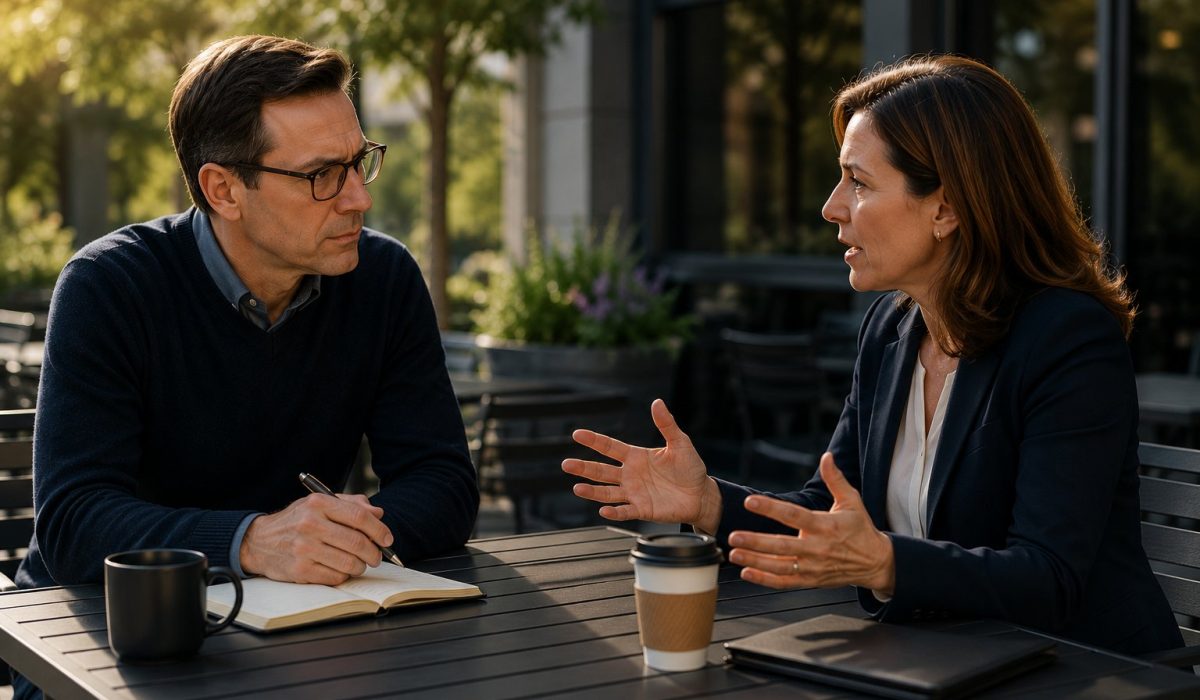
They carried their coffee outside to a small courtyard between the buildings. The corporation had provided several metal tables there, presumably to encourage employees to take breaks, though most people seemed to use them for meetings that happened to include sunlight. The afternoon had begun cooling, and the shadows from the buildings reached halfway across the courtyard.
She sat opposite him and rested both hands around her coffee.
"I need your help with something."
"What kind of help?"
She smiled.
"The kind you're annoyingly good at."
He waited.
"You know those meetings where everyone leaves with the impression that something happened, and then two days later you discover everybody has a different idea of what it was?"
"Most meetings?"
She laughed. "That's why I'm asking you."
He liked that she didn't rush into the explanation. She looked across the courtyard for a moment, apparently deciding where the problem began.
"It's my group. We've been working on the implementation plan for almost a month. I have three people who know the system better than anyone in the company, and every one of them is intelligent enough to make a convincing argument for what we should do next. That's become the problem."
"Three different arguments?"
"Not exactly. If they were openly disagreeing, I could deal with it. They agree with one another just enough to keep the conversation pleasant. Then they go back to their desks and continue doing what they thought we decided."
He smiled. "Ah."
"Yes. Ah."
"How long has this been going on?"
"Three meetings. Maybe four, depending on whether you count the one where I still thought we were making progress."
He took a drink of coffee and considered what she had said.
"Give me an example."
She did.
The project involved replacing part of an internal system that had grown cumbersome over the years. One member of her team wanted to modify what they already had. Another believed they should replace it entirely. The third was less interested in the technology than in keeping the transition from disrupting the people who used it every day.
"All three positions are reasonable," she said. "That's what makes it difficult. Nobody is obviously wrong."
"Those are the worst kind."
"I was afraid you'd say that."
"No, they're interesting. If somebody is obviously wrong, you don't really have a problem."
She watched him over the rim of her cup.
"You actually believe that, don't you?"
"Mostly."
This time her laugh came more easily.
For several minutes he asked questions. Who was responsible for the final decision? What would happen if they delayed another month? Had the group agreed on what success looked like? Which parts of the project were fixed requirements and which were preferences?
She answered carefully.
As she talked, Focus Man felt the problem beginning to arrange itself.
It was a sensation he had difficulty explaining to people who didn't experience it. At first there was simply information—names, opinions, dates, constraints. Then relationships appeared among them. Certain facts became important while others receded. What had seemed like a collection of disagreements began to reveal a structure.
He could almost see the meeting.
Three intelligent people were answering three different questions.
One was asking, What is technically best?
Another was asking, What can we realistically accomplish?
The third was asking, What will cause the least disruption?
Because no one had stated the question they were actually trying to answer, each could leave the room believing the others had agreed.
He started to tell her.
Then she interrupted him.
"Actually, that's what I wanted to ask."
He stopped.
"I want you to come to the next meeting."
He hadn't expected that.
She leaned back slightly.
"Just sit in. Listen to them for twenty minutes. Then tell us what we're doing wrong."
"You're assuming you're doing something wrong."
"We've had four meetings and still don't have a decision."
"That isn't necessarily the same thing."
She gave him a look that suggested patience had limits.
"Would you come?"
His first instinct was yes.
The request appealed to him. There was a certain pleasure in being asked to do something other people believed you did particularly well, and he was not immune to it. More than that, the problem interested him. He was already curious about the three people in the room and whether the pattern he imagined was actually there.
He could picture himself listening for half an hour, walking to the board, writing the three competing questions in separate columns, and watching the conversation change.
It would probably work.
That was what made him hesitate.
She noticed.
"I thought you'd like this."
"I do."
"Then why do you look worried?"
"I'm not worried."
He searched for the thought.
"You asked me to tell you what you're doing wrong."
"Right."
"But you're the manager."
"Unfortunately."
"They're your people."
"Also unfortunately."
He smiled, but she didn't let him escape into the joke.
"What are you getting at?"
He looked across the courtyard. Someone came through the doors carrying a briefcase, nodded to them, and continued toward the parking lot.
"I'm wondering what happens the meeting after I'm gone."
She was quiet.
Focus Man continued.
"Suppose I come in. Suppose you're right and I see whatever is keeping you stuck. I put it on the board, everybody says that's exactly the problem, you make the decision, and everyone goes home happy."
"That sounds wonderful."
"It does."
"So I'm missing the downside."
"The next time they get stuck, what happens?"
She considered that.
"We work through it."
"Maybe. Or you come find me."
"Would that be terrible?"
"No. I'd probably enjoy it."
She smiled. "I'm beginning to understand the problem."
"I'm not sure I do yet."
That was true.
He wasn't trying to teach her anything. He was thinking aloud, and the thought interested him because it ran against his instincts. He liked fixing things. If someone asked for help and he could provide it, helping seemed self-evidently better than standing aside.
Yet something about entering another manager's meeting and reorganizing it for her felt too easy.
He asked, "At the beginning of these meetings, what do you tell them has to be decided?"
"The agenda goes out beforehand."
"That's not what I asked."
She frowned.
He waited.
Finally she said, "I tell them what we're discussing."
"Right."
"And?"
"What do you tell them they have to decide?"
She started to answer and stopped.
For the first time since they sat down, she looked less frustrated than curious.
"I'm not sure I do."
He nodded.
The courtyard had grown quieter around them. Most of the offices behind the windows were empty now, and the late sunlight had climbed the opposite wall until only a narrow strip remained.
She picked up her coffee, discovered it had gone cold, and put it down again.
"So what are you suggesting?"
"At the next meeting, don't start with the agenda."
"Okay."
"Start by writing one sentence on the board."
"What sentence?"
He thought for a moment.
"'By the end of this meeting, we will decide...' Then finish it."
She looked skeptical.
"That's it?"
"No."
"I knew there was more."
"Then ask each of them what information they need in order to make that decision. Not what solution they prefer. What they need to know."
She nodded slowly.
"And when they start arguing?"
"They will."
"Helpful."
"Don't stop them too quickly. Make them argue about the same question."
That brought another smile.
He continued, "Right now I think they're disagreeing very politely about different things. If you can get them disagreeing honestly about the same thing, you might actually get somewhere."
She sat with that for a while.
Focus Man resisted the urge to fill the silence. He had already said more than he intended.
Eventually she asked, "And if it doesn't work?"
"Then come get me."
"Now we're negotiating."
"Apparently."
She laughed.
"All right. I'll try it your way."
"It's not my way."
"It certainly isn't mine."
"That's the point."
She gave him a look that said she was not entirely convinced by that distinction, but she gathered her papers and stood.
They walked back toward the building together.
At the door she stopped.
"You know, when I asked you out here, I thought you'd say yes in about ten seconds."
"So did I."
"What happened?"
He considered the question.
"I don't know."
It was the most honest answer he had.
She shook her head, smiling.
"You're getting complicated."
He held the door for her.
"I'll work on that."
They separated in the hallway, she toward her office and he toward the elevators.
On the drive home, he thought about the conversation more than he expected to.
There was nothing remarkable about it. A coworker had asked for help. He had offered a suggestion instead. Monday would arrive, her team would meet again, and perhaps his idea would work or perhaps she would come looking for him before lunch.
What stayed with him was the moment when he had almost said yes.
For much of his professional life, competence had meant being able to provide the answer. He had worked hard to become the person people sought when something became difficult. There was pride in that role, and usefulness too. Organizations needed people willing to step into confusion and impose enough order to move forward.
He wasn't ready to distrust that ability.
But for the first time he had glimpsed another possibility.
Perhaps being useful did not always require becoming necessary.
The thought was still too new to become a principle. He didn't write it down. He didn't even know whether he believed it yet.
He simply carried it home with him.
Years later, he would recognize that afternoon as one of the first times he resisted the particular pleasure of solving someone else's problem.
It would take him much longer to understand why that mattered.
Posted in focus-man by Geoff Stevens