
Focus Man: The First Ride
Chapter 3
He remembered the bicycle more clearly than seemed reasonable after all those years.
It was a Raleigh three-speed, dark-colored and substantial, with a narrow saddle and a small lever that changed the gears with a clean mechanical click. Someone had explained the three speeds to him, probably more than once, and he understood that this made it a better bicycle than the simpler ones he had ridden before. But the machinery wasn't what stayed with him. What mattered was that the bicycle belonged to him.
Ownership carried a different meaning when you were a boy. There were things in the house that were technically his—clothes in his dresser, books on a shelf, toys accumulated over birthdays and Christmases—but a bicycle belonged to you in a more consequential way. It waited where you had left it. You were responsible for bringing it home. And once you learned what it could do, it could take you beyond the places where anyone expected to find you.
The street in front of the house sloped downhill. Walking it, the grade seemed hardly worth noticing, but a bicycle understood gravity better than a boy did. The moment he pushed away from the curb, the wheels began gathering speed. At first he held the handlebars too tightly, feeling every crack in the pavement through his arms, testing the brakes more often than necessary and learning that small movements were enough to change direction. The bicycle seemed eager in a way that made him both cautious and thrilled.
Before long, riding around the neighborhood wasn't enough.
Montrose lay beyond the familiar streets. It wasn't far by any adult measure, but childhood distances were measured differently. A place could be only a few miles away and still belong to another world if you had always needed someone else to take you there.
Montrose had the Shopping Bag grocery store, the bowling alley, and the movie theater with its single screen and marquee facing the street. There was also the sporting-goods store, which interested him more than almost anything else. He could wander among baseball gloves, fishing gear, balls, bats, and things whose uses he only partly understood, imagining possession as children do, with very little concern for money or practicality.
Until the Raleigh, Montrose was a place adults drove to.
Then one day it became a place he might reach himself.
He could no longer remember whether he announced his intention to anyone. Perhaps he did. Childhood independence in those years existed inside boundaries that seemed astonishingly loose by later standards. Parents expected children to disappear for hours and eventually return, preferably before dinner. A bicycle widened the accepted territory considerably.
The route began with the hill.
There was no easing into it. Once he pushed off, gravity made the first decision for him. The houses began slipping past more quickly, the wind grew louder around his ears, and the pedals briefly became unnecessary. He knew the bottom of the hill was coming and with it the wooden bridge, but knowing did little to slow the exhilarating sensation of being carried forward by something he had started but no longer entirely controlled.
The bridge crossed a wash that was usually dry or nearly so. In later years a storm would tear the old bridge away and a concrete replacement would appear in its place, engineered to withstand what the wooden structure could not. Eventually he would cross the new bridge without giving it any thought.
But the bridge of his childhood was made of wood.
He remembered the change in sound when the bicycle reached it. Rubber tires left pavement and began humming and rattling over boards, producing a hollow vibration that traveled through the frame and into his hands. The bridge wasn't especially long, but crossing it felt like passing from one part of the journey into another.
Beyond it came the boulevard, wider and busier than the neighborhood streets. Traffic introduced a seriousness that had been absent on the hill. He waited, watched, judged the distance of approaching cars, and crossed when the opening seemed large enough.
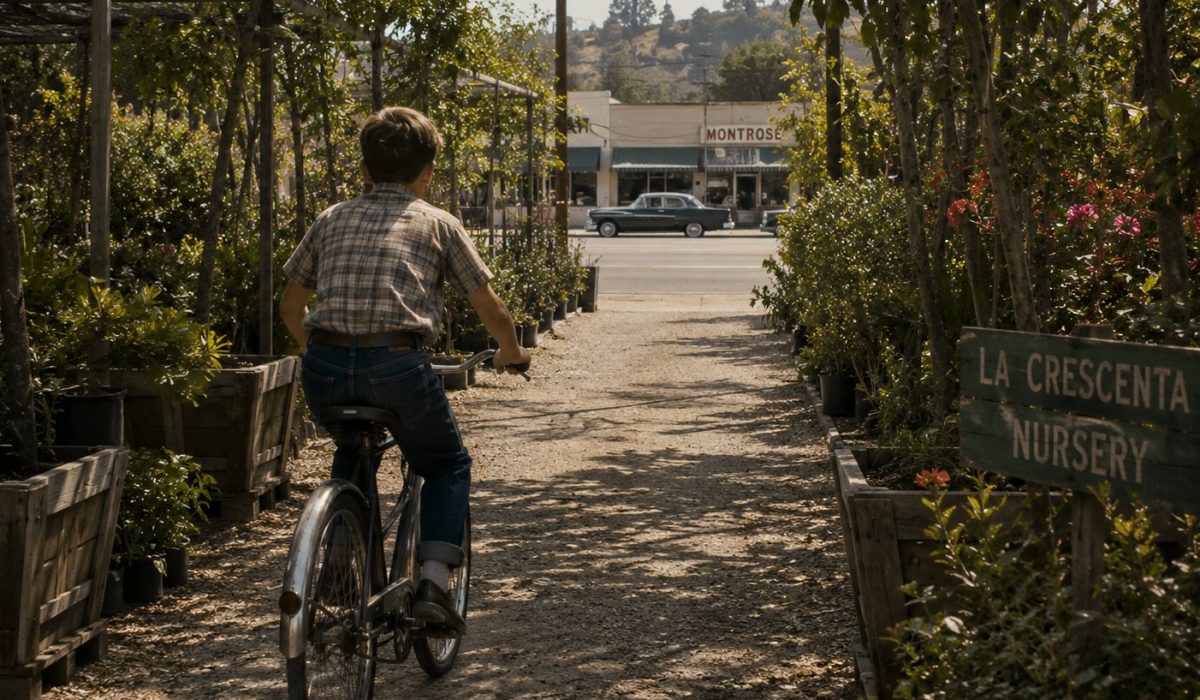
Then came the nursery.
Years later, when he tried to explain the route, the nursery was always the part that sounded improbable. It was not simply a business beside the road. Somehow it had become part of the way through. Rows of shrubs and young trees created narrow passages, and the route wandered among them rather than following anything that could properly be called a street.
He loved that part.
The air seemed different beneath the leaves. The noise from the boulevard diminished, and the world became green and enclosed. He rode slowly there, steering between rows of plants, choosing one opening and then another. Sunlight fell unevenly across the ground. There was no painted line telling him where to go and no sign promising that the path he had chosen would emerge where he hoped.
He simply kept moving.
Perhaps that was one of the first things the bicycle taught him: getting somewhere did not always require knowing the entire route before you began.
On the far side of the nursery, the streets became residential again. They were unfamiliar, but no longer intimidating. He knew Montrose was somewhere ahead. Each intersection required a small decision, and each correct turn brought something recognizable into view.
Then, almost without ceremony, he was there.
That was the remarkable part.
There was no finish line, no sign announcing that he had accomplished anything unusual. The streets simply became streets he recognized. The Shopping Bag appeared. The bowling alley was where it had always been. The movie theater stood beneath its marquee. The sporting-goods store waited with all those things he liked to examine even when he had no money to buy them.
Montrose itself hadn't changed.
He had.
For the first time, he had arrived without sitting in the passenger seat of someone else's car. No parent had decided when to leave or where to park or how long they would stay. He could lean the Raleigh against something, walk into the sporting-goods store, look as long as he wanted, then come outside and decide for himself what happened next.
The freedom was modest by any adult standard. He had traveled only a few miles from home.
But childhood is filled with borders adults can no longer see, and that afternoon he had crossed one.
The ride home required more work. Hills that had generously supplied speed in one direction demanded repayment in the other. He learned to use the three-speed for something other than the pleasure of hearing it click. His legs tired. The distance seemed longer.
None of that mattered.
He knew the way now.
The nursery was no longer mysterious. The boulevard could be crossed. The wooden bridge led back to the hill, and the hill eventually led home.
In the months and years that followed, he made the ride often enough that its discoveries became routine. The turns ceased requiring thought. The passage through the nursery acquired a preferred line. When the storm eventually took the wooden bridge and the concrete one replaced it, even that became ordinary. Familiarity did what it always does: it made a once remarkable world seem inevitable.
But age restored some of the wonder familiarity had taken away.
Looking back, Focus Man understood why that first ride had remained when so many other childhood afternoons had disappeared.
The Raleigh had given him more than transportation. It had introduced him to a particular kind of freedom—the freedom of discovering that the world extended farther than the boundaries someone else had drawn for him.
There would be other bicycles.
There would be rides hundreds of miles from that neighborhood, over mountains and through places the boy on the Raleigh could not have imagined. There would be maps and routes and computers mounted on handlebars telling him precisely where to turn.
But none of them would enlarge the world quite as much as that first ride to Montrose.
The distance had been small.
The world beyond it had not.
Posted in focus-man by Geoff Stevens