
Focus Man: The Game
Chapter 4
It didn't take much to start a football game in those days.
Someone had a ball. Someone else had an hour before dinner. That was usually enough.
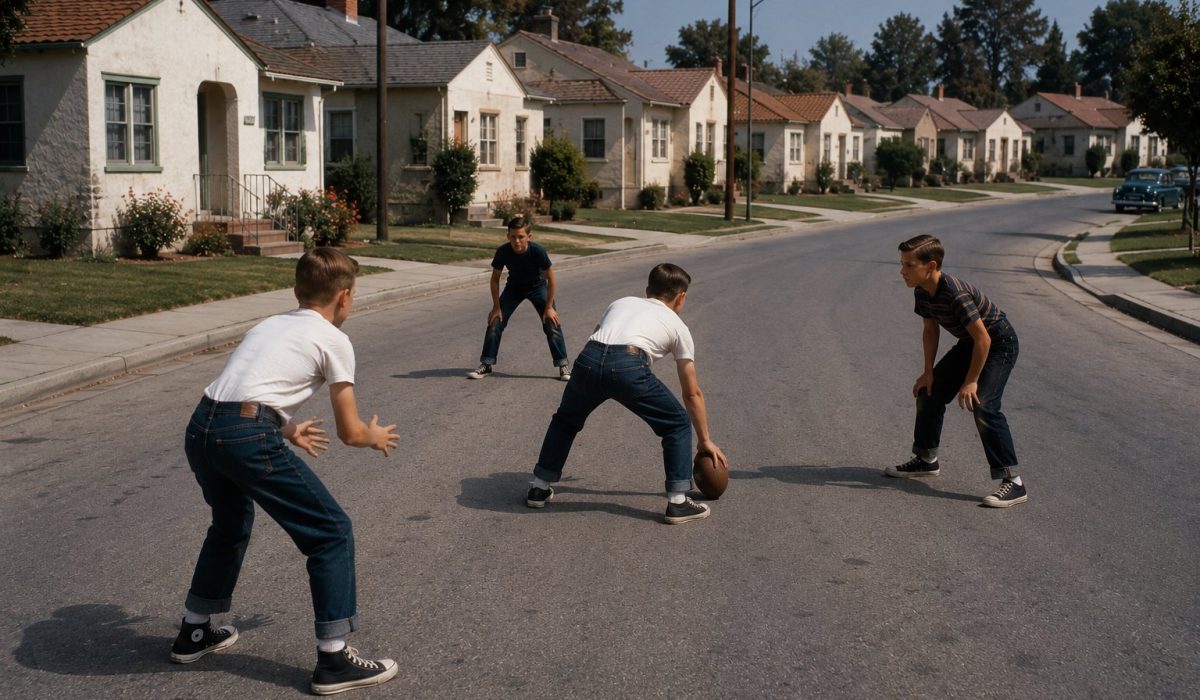
At the upper end of Eilinita, the street flattened briefly before beginning its long descent toward the houses below. No one would have mistaken it for a football field. There were no sidelines except the curbs, no yard markers, no goalposts, and certainly no grass. The pavement was hard enough to leave a boy carrying evidence of almost every game on his knees and elbows.
None of that seemed important.
To him and Tom, it was a stadium.
They played two against two when other boys appeared, but some of the games he remembered best involved only the two of them. With two players there was no need to choose teams, argue over positions, or decide who got the ball first. One boy threw. The other ran. Then they traded places.
The rules were whatever they needed to be.
A telephone pole might mark the end zone for one series and a driveway the next. A completed pass beyond the Johnsons' mailbox was probably a touchdown unless someone remembered that the mailbox had been the twenty-yard line five minutes earlier. Disagreements seldom lasted because there was another play waiting, and the next play was always more interesting than the previous one.
Most began with the same instruction.
"Go long."
There were surely other plays available to them. Professional football teams had playbooks thick with diagrams, blocking assignments, crossing patterns, screens, reverses, and things two boys barely understood.
None of them offered the satisfaction of throwing the ball as far as you possibly could.
Tom would take off down the street.
He was fast, though not gracefully so. His feet kicked outward slightly when he ran, giving him an odd, loose-limbed gait that should have slowed him down but somehow didn't. If anything, it made him harder to catch.
One afternoon they had decided who he resembled.
Elroy Hirsch.
Crazy Legs.
Hirsch played for the Los Angeles Rams, and even the nickname seemed made for a boy running crookedly down Eilinita.
After that, Tom wasn't merely Tom when he ran a deep route.
He was Crazy Legs Hirsch, number 40.
Focus Man would hold the football near his chest and drop back several steps, though there was no defensive line coming after him and therefore no reason to drop back at all. Quarterbacks dropped back. That was reason enough.
For those few seconds he wasn't a boy standing in the middle of a residential street.
He was Norm Van Brocklin.
Number 11.
The Dutchman.
He would plant his back foot and throw.
The passes were seldom beautiful. Some wobbled. Some sailed too high. Others began promisingly and then seemed to lose interest halfway to their destination. But every so often the ball left his hand properly, spinning against the blue California sky while Tom raced beneath it.
Those were the throws he remembered.
Tom would glance backward without slowing, make some peculiar sideways adjustment, and stretch his arms toward the descending ball. Sometimes it bounced off his fingertips and skittered along the pavement.
Sometimes he caught it.
Those catches were magnificent.
"Touchdown!"
There was no crowd to confirm it.
They didn't need one.
They had heard crowds on television. They knew what sixty thousand people sounded like when the Rams scored. Imagination supplied whatever Eilinita lacked.
On Sunday afternoons the heroes were men whose names seemed larger than ordinary names. Van Brocklin. Hirsch. Ollie Matson. Jon Arnett. They wore helmets without face masks complicated enough to hide their faces, and they played on the grainy television screen with an authority that made professional football seem like one of the permanent institutions of the world.
On Monday afternoon, those same men appeared on Eilinita.
At least in the minds of two boys.
Occasionally reality required the NFL to suspend play.
"Car!"
One of them would grab the football and they would retreat to opposite curbs.
A Chevrolet or Ford would come slowly up the street, its driver passing between the two boys with the mildly tolerant expression of an adult who understood that the roadway had temporarily been reassigned. Sometimes the driver lifted a hand. The boys waited impatiently for the car to clear the field.
Then they stepped back onto the pavement.
No discussion.
No ceremony.
The game resumed.
Dogs sometimes participated from behind fences. One neighborhood dog seemed personally offended by every completed pass and raced the length of its yard barking while the receiver ran down the street. The boys eventually incorporated him into the game, assigning additional greatness to any catch made while the dog was in pursuit on the other side of the fence.
Afternoons seemed longer then.
That was one of the mysteries Focus Man noticed only after growing older. Childhood summers appeared to contain considerably more hours than adult summers, though the clocks insisted otherwise. A game could begin after school and seem to occupy an entire day before somebody's mother finally called from a doorway.
Dinner.
That was usually the clock that mattered.
Until then they played.
When it was his turn to run, Focus Man approached the game differently from Tom. Tom simply took off, trusting speed and Crazy Legs to solve whatever happened next. Focus Man thought about where the ball ought to arrive. He would run straight for several steps, glance back, change direction, and try to time the route so the throw and the runner reached the same place together.
Even then, perhaps, he liked patterns.
But he didn't think about that.
He was a boy playing football.
Tom threw differently too. His passes tended to arrive lower and harder. Focus Man learned to watch the ball all the way into his hands, particularly on the pavement where dropping it meant chasing it halfway down the hill.
One pass came toward him barely above the street. He bent, got both hands beneath it, and gathered the ball against his chest just before it touched the ground.
Tom protested immediately.
"That hit."
"It did not."
"It hit the ground."
"I caught it."
Tom walked closer and considered the evidence, of which there was none.
"Close enough."
And that settled it.
They didn't keep score very carefully. Sometimes they didn't keep score at all. Victory had little meaning when teams consisted of one player each and possession changed whenever someone felt like changing it. What mattered was the next throw.
There was always another chance to make the perfect one.
Looking back across all the years that followed, Focus Man found it strange how vividly those games remained. He had forgotten entire school years, forgotten teachers whose classrooms he occupied five days a week, forgotten tests and assignments and countless supposedly important events.
But he could still see Tom running down Eilinita with his feet kicking outward.
He could still feel the football in his hands.
He could still remember waiting for the rare car to pass so they could reclaim the street.
Perhaps the memory endured because nothing depended on those afternoons.
There were no standings. No coaches. No parents watching from folding chairs. Nobody recorded statistics or selected an all-star team. Neither boy was building a résumé or developing skills intended to produce some future advantage.
They weren't even trying to become better people.
They were playing.
That seemed almost radical to him now.
So much of adult life eventually acquired purpose. Exercise became fitness. Reading became self-improvement. Hobbies became accomplishments. Even recreation could be measured by miles, averages, rankings, photographs, and records carefully preserved by devices that accompanied people everywhere.
On Eilinita, none of that existed.
A football traveled through the afternoon air.
A boy ran beneath it.
Sometimes he caught it.
Sometimes he didn't.
Then they did it again.
Years later there would be other games and other heroes. There would be work and responsibility and the long education of discovering that nearly everything worth having carried some obligation with it.
But for a few childhood afternoons, the world asked almost nothing of him.
Someone had the ball.
That was enough.
Posted in focus-man by Geoff Stevens