
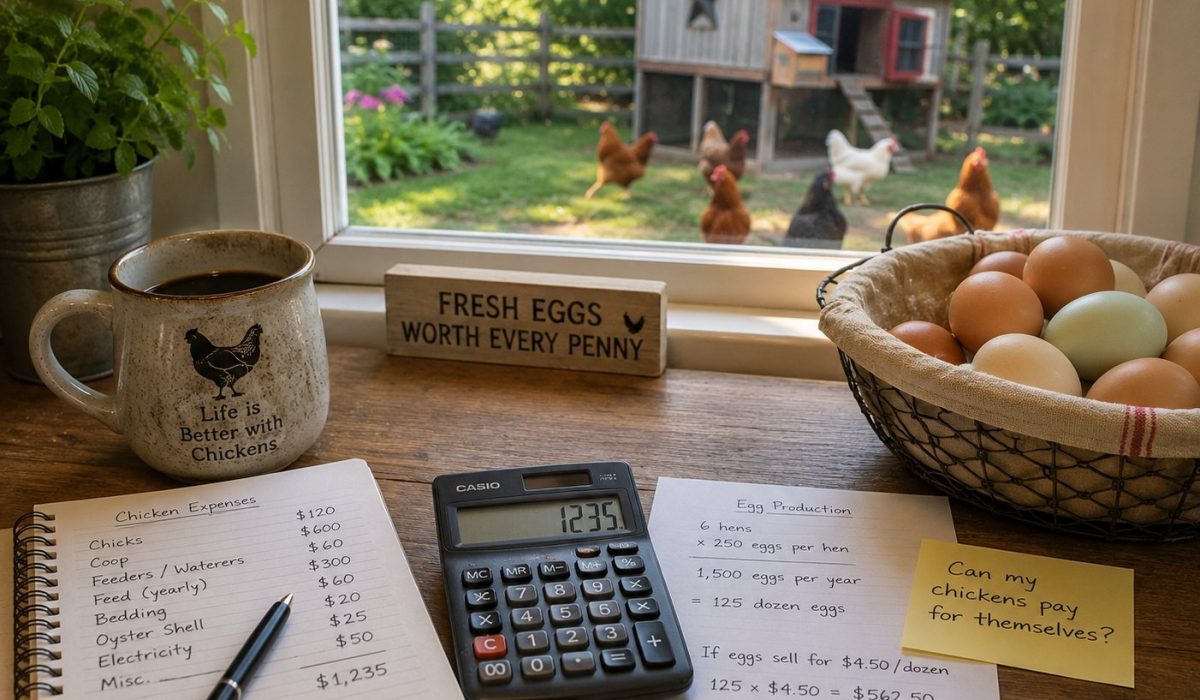
Calculating Your Cost Per Egg
One of the most interesting exercises for backyard chicken owners is figuring out exactly what each egg costs to produce. While most people don't raise chickens solely to save money, understanding your cost per egg can help you make informed decisions about flock size, feed choices, and whether selling extra eggs might offset some expenses.
The calculation is surprisingly simple.
Start with Annual Expenses
First, add up your annual chicken-related costs.
Common expenses include:
-
Feed
-
Bedding
-
Oyster shell or calcium supplements
-
Grit
-
Coop maintenance
-
Replacement equipment
-
Electricity for heated waterers or winter lighting
-
Miscellaneous supplies
For this example, let's assume the following annual costs:
| Expense | Annual Cost |
|---|---|
| Feed | $320 |
| Bedding | $60 |
| Oyster Shell & Grit | $25 |
| Coop Maintenance | $45 |
| Miscellaneous | $50 |
| Total | $500 |
Notice that we are not including the original coop construction cost. Many owners treat the coop as a long-term investment and spread that cost over several years.
Estimate Annual Egg Production
Next, calculate how many eggs your flock produces in a year.
Let's assume you have six hens that average 250 eggs each annually.
6 hens × 250 eggs = 1,500 eggs
Since there are 12 eggs in a dozen:
1,500 ÷ 12 = 125 dozen eggs
Calculate Cost Per Egg
Now divide your annual expenses by the number of eggs produced.
$500 ÷ 1,500 eggs = $0.33 per egg
Or:
$500 ÷ 125 dozen = $4.00 per dozen
In this example, each egg costs about 33 cents to produce.
Why Your Numbers May Differ
Every flock is different.
Your cost per egg may be higher or lower depending on:
-
Feed prices in your area
-
Breed selection
-
Climate
-
Coop size
-
Predator losses
-
Egg production levels
-
Whether birds free-range part of the day
A flock of high-producing Leghorns or Golden Comets will generally produce a lower cost per egg than a flock of ornamental or heritage breeds that lay fewer eggs.
Don't Forget Molting and Aging
Many new owners assume hens will produce the same number of eggs every year.
In reality:
-
Production usually drops with age.
-
Hens may stop laying during molts.
-
Winter production often declines.
Because of this, it helps to average production over several years rather than relying on the best year alone.
What About the Coop?
If your coop cost $1,500 and lasts ten years, you might allocate:
$1,500 ÷ 10 = $150 per year
Adding that amount to the previous example would increase annual costs to:
$650 per year
Now the calculation becomes:
$650 ÷ 125 dozen eggs = $5.20 per dozen
This provides a more complete picture of the true long-term cost.
Comparing to Store-Bought Eggs
The comparison isn't always straightforward.
Grocery store egg prices fluctuate significantly. Sometimes store eggs cost less than your calculated production cost. Other times, especially during shortages, backyard eggs may be less expensive.
Many chicken owners prefer comparing their eggs to premium pasture-raised or free-range eggs rather than the lowest-priced grocery options.
The Value Beyond the Numbers
Most chicken owners eventually discover that cost per egg tells only part of the story.
Backyard eggs often provide:
-
Superior freshness
-
Richer yolks
-
Better flavor
-
Confidence in how the hens are raised
-
Enjoyment of the hobby itself
When viewed strictly as a financial investment, chickens may or may not save money.
When viewed as a source of fresh food, entertainment, education, and connection to a simpler lifestyle, the value often extends far beyond what any calculator can measure.
In the end, calculating your cost per egg is useful—but many chicken owners would tell you that the best part of raising chickens isn't the math. It's collecting that first warm egg from the nest box and knowing exactly where it came from.
Posted in eggs--profit by Erik Johansson