
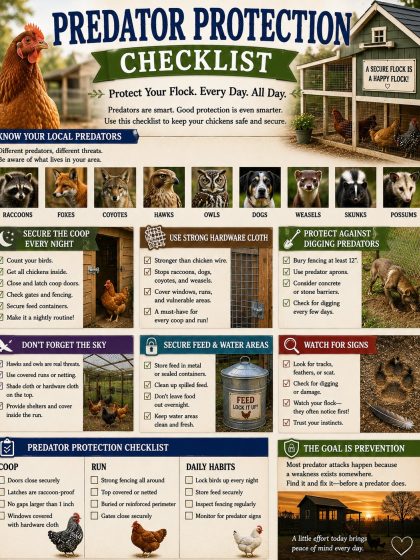
Predator Protection Checklist
Ask experienced chicken owners about their biggest concern, and many will give the same answer:
Predators.
A healthy flock can be thriving one day and suffer losses the next if predators discover an easy opportunity.
The good news is that most predator problems can be prevented with proper planning, secure housing, and a few good habits.
Think of predator protection as insurance for your flock. The effort invested today can save a great deal of heartbreak later.
Know Your Local Predators
The first step is understanding what lives in your area.
Common chicken predators include:
-
Raccoons
-
Foxes
-
Coyotes
-
Hawks
-
Owls
-
Domestic dogs
-
Bobcats
-
Weasels
-
Skunks
-
Possums
Different predators hunt in different ways, which means protecting chickens often requires multiple layers of defense.
Secure the Coop Every Night
Many predators hunt after dark.
A secure nighttime coop remains one of the most effective forms of protection.
Each evening:
✓ Count your birds
✓ Make sure all chickens are inside
✓ Close and latch coop doors
✓ Check gates and fencing
✓ Secure feed containers
Many chicken owners develop a simple evening routine that becomes second nature.
Use Strong Hardware Cloth
One of the most common mistakes new chicken owners make is relying solely on ordinary chicken wire.
Chicken wire is useful for containing chickens.
It is not designed to stop determined predators.
Hardware cloth is much stronger and offers better protection against:
-
Raccoons
-
Dogs
-
Coyotes
-
Weasels
Many experienced owners consider hardware cloth one of the best investments they can make.
Protect Against Digging Predators
Foxes, coyotes, and dogs often attempt to dig under fencing.
Consider:
-
Buried fencing
-
Predator aprons
-
Concrete borders
-
Deep fence posts
A fence that looks secure above ground may still be vulnerable below ground.
Don't Forget the Sky
Many chicken owners focus on ground predators and forget about aerial attacks.
Hawks and owls can be significant threats, especially to smaller birds.
Protection options include:
-
Covered runs
-
Netting
-
Shade cloth
-
Trees and shelters
Providing places where chickens can quickly hide helps reduce risk.
Secure Feed and Water Areas
Feed attracts more than chickens.
It can also attract:
-
Rodents
-
Raccoons
-
Skunks
-
Other unwanted visitors
Store feed in secure containers with tight-fitting lids and clean up spilled feed whenever possible.
Watch for Signs of Predator Activity
Predators often leave clues before an attack occurs.
Look for:
-
Tracks
-
Feathers
-
Digging attempts
-
Damaged fencing
-
Unusual flock behavior
Chickens are often the first to notice when something is wrong.
A nervous or unusually quiet flock may indicate a nearby predator.
Consider Your Free-Range Strategy
Free-ranging offers many benefits, but it also increases exposure to predators.
If you allow birds to roam:
✓ Supervise when possible
✓ Provide nearby cover
✓ Return birds to the coop before dusk
✓ Be aware of local predator activity
Many owners find a balance between free-ranging and secure confinement.
Predator Protection Checklist
Use this simple checklist to evaluate your setup:
Coop
☐ Doors close securely
☐ Latches cannot be opened by raccoons
☐ No gaps larger than one inch
☐ Windows protected with hardware cloth
Run
☐ Strong fencing
☐ Covered top or netting
☐ Buried or reinforced perimeter
☐ Gates close securely
Daily Habits
☐ Lock birds up every night
☐ Store feed securely
☐ Inspect fencing regularly
☐ Monitor for predator signs
The Goal Is Prevention
Most predator attacks happen because a weakness exists somewhere in the system.
A loose latch.
A hole in the fence.
A forgotten gate.
The best time to find these weaknesses is before a predator does.
Peace of Mind
Predator protection may not be the most exciting part of chicken keeping, but it is one of the most important.
A secure coop allows chickens to live safely and gives owners confidence that their flock is protected.
And when the sun sets each evening, few things are more satisfying than knowing the birds are safely tucked away for the night, ready to greet another morning.
Posted in resources by Erik Johansson