
The River-Chapter 5
The Practice
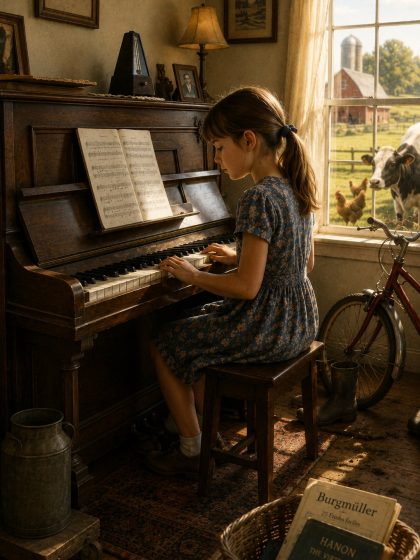
The piano occupied a prominent place in the farmhouse living room. It was large, polished, and impossible to ignore. Visitors noticed it immediately upon entering the house, and the girl's mother preferred it that way. Music was important in the family. Lessons were expected, practice was required, and excuses were rarely accepted.
The girl understood all of that in theory. In practice, however, there were many things competing for her attention.
Outside the farmhouse windows stretched a world that seemed far more interesting than scales and finger exercises. There were fields to explore, animals to feed, and horses waiting to be ridden. A creek wound through part of the property, disappearing into stands of trees that invited investigation. Every season brought new discoveries. Spring meant calves and lambs. Summer meant long evenings that seemed to last forever. Autumn arrived with harvests and changing leaves, while winter transformed familiar places into entirely new landscapes.
The piano, by comparison, remained stubbornly unchanged.
Every afternoon brought the same routine. Sit on the bench. Open the music book. Practice the assigned lesson. Repeat the difficult passages. Count the rhythm correctly. Begin again when mistakes appeared. The process seemed endless to a child whose mind was already wandering toward the barn, the pasture, or the bicycle leaning against the porch.
She was not rebellious. She did not hate music. In truth, she rarely thought about it enough to hate it. She simply couldn't understand why anyone would choose to spend an afternoon indoors repeating the same measures over and over when there was an entire farm waiting outside.
Her mother saw things differently.
Being a piano teacher, she recognized progress that her daughter could not. Small improvements that seemed insignificant to the girl stood out clearly to trained eyes. A smoother transition between notes. Better timing. More confidence in difficult passages. Skills were developing even when the student herself remained unaware of them.
The girl often treated practice as an obstacle to be completed as quickly as possible. She would watch the clock, calculate how many minutes remained, and imagine all the things she planned to do once she was released. Sometimes she rushed. Sometimes she daydreamed. Occasionally she became so distracted by thoughts of the outside world that she had to start a piece over because she could no longer remember where she was on the page.
Yet something interesting was happening beneath the surface.
Without realizing it, she was learning discipline.
Not the dramatic kind associated with great accomplishments or public recognition. A quieter form. The habit of showing up. The understanding that improvement often arrives gradually. The willingness to continue even when something is not immediately enjoyable.
Those lessons entered her life disguised as piano practice.
Years later she would remember particular pieces of music long after she had forgotten the exercises she once considered so tedious. Melodies stored themselves somewhere deep in memory. Her fingers learned patterns that remained available decades later. More importantly, she discovered that persistence in one area often transfers to another. The patience required to master a difficult passage was not entirely different from the patience required to master other challenges life would eventually present.
At the time, however, none of that was obvious.
What she noticed was that whenever practice ended, the outdoors was still waiting. The bicycle was still leaning against the porch. The animals still needed attention. The fields still stretched toward the horizon. Life resumed exactly where it had paused.
And so the years passed in a familiar rhythm. Practice first. Adventure afterward.
Looking back, she sometimes laughs at how determined she was to escape the piano bench. Had someone told her then that music would remain part of her life for decades, she probably would have been surprised. Had they suggested that the lessons were shaping her in ways she could not yet see, she likely would have nodded politely and returned her attention to the bicycle outside.
Children rarely recognize the importance of experiences while they are living them.
That understanding usually arrives much later.
Like a river that gathers strength from countless small streams, the person she would eventually become was being shaped by influences she barely noticed at the time. The farm taught independence. The animals taught responsibility. The bicycle taught freedom. The piano taught patience.
Together they formed a current that would carry her far beyond the boundaries of the farm where it all began.
Posted in the-river by Geoff Stevens