
The River-Chapter 8
The Bend in the River
The woman had ridden this stretch of road many times before. It was one of those routes that had become familiar enough that she no longer needed to think much about where she was going: a gradual climb out of town, several miles through open country, and then a winding descent toward the river. She knew where the pavement narrowed and where the wind was likely to find her. She knew the places where the grade looked almost flat but somehow wasn't, and the long stretch on the return where tired legs could make a familiar road seem considerably longer than it had that morning.
Usually she rode through all of it without paying much attention to the landmarks. The attraction was partly the exercise and partly the solitude, but there was also satisfaction in the uncomplicated act of moving forward under her own power. A bicycle required enough attention to keep other concerns from becoming too intrusive. There was the road, the cadence of her legs, the sound of tires against pavement, and the occasional calculation of whether the hill ahead deserved another gear.
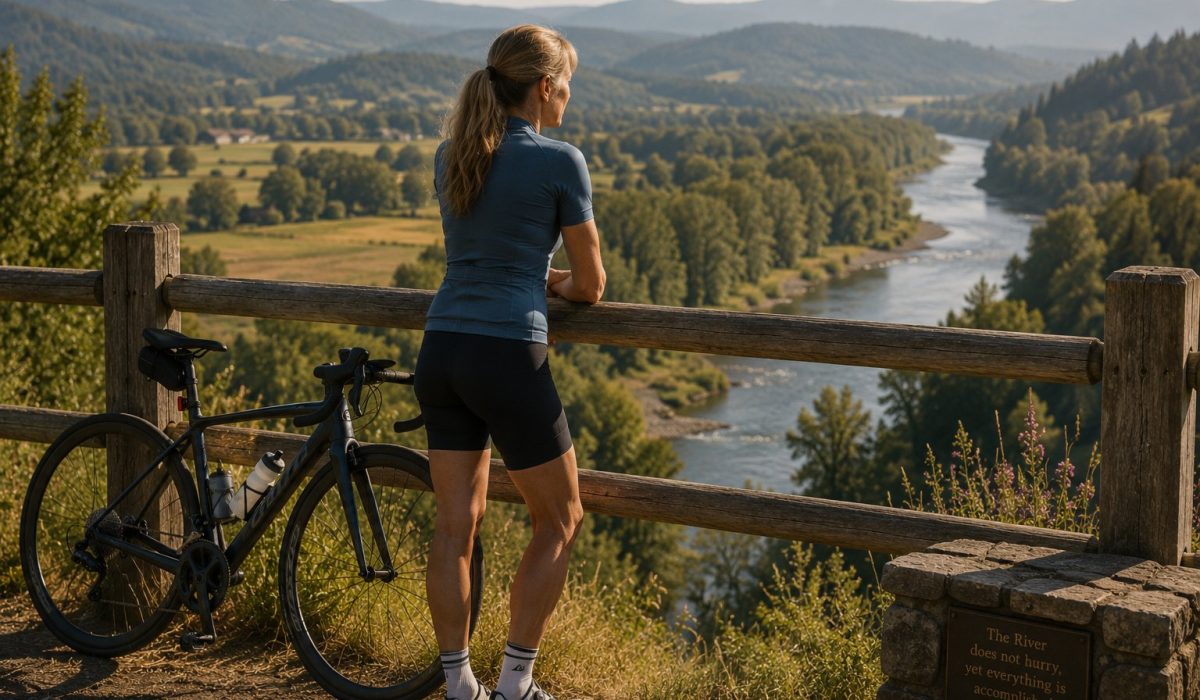
That morning, though, she slowed as she approached one of her favorite overlooks. The river below was neither particularly large nor dramatic, and perhaps that was one reason she liked it. It simply moved through the landscape as it always had, following a course established long before anyone had thought to build a road above it. She coasted to a stop, leaned the bicycle against the fence, and walked toward the overlook.
At fifty-eight, she had begun thinking about time differently. It wasn't fear of getting older, at least not most days. She was healthy, strong enough to be standing beside a bicycle after climbing the road behind her, and still curious about what might lie ahead. What interested her more was the improbable collection of things that had brought her to this particular place. A life that seemed perfectly ordinary while she was living it had become, in retrospect, surprisingly difficult to summarize.
There had been the farm and the piano, the animals and the bicycles, and long summer evenings when adulthood seemed too distant to require much thought. There had been horses and the hours she had willingly spent in barns and corrals, learning things she hadn't understood at the time as lessons at all. Then college had arrived, followed by law school and the years of determination required to turn an education into a profession. There had been clients and deadlines, negotiations and difficult conversations, and countless problems brought to her by people who hoped she could make sense of them.
Those years seemed both far away and remarkably close. She could remember particular offices, particular clients, the arrangement of furniture in rooms she hadn't entered for years. She remembered the peculiar satisfaction of solving something difficult and the less satisfying realization that one solved problem was often replaced almost immediately by another. For a long time she had assumed that was the life she would continue living until retirement. She had built a successful legal practice, and there was no obvious reason to leave it. Continuing was what people generally did when something was working.
Then, several years earlier, an opportunity had appeared that made considerably less sense on paper than the life she already had. A medical technology company offered her a position that would allow her to work remotely. The work was different, the environment unfamiliar, and the future less certain than the practice she had spent years building. Some people around her questioned why she would exchange something established for something she could not yet predict.
She had wondered the same thing.
Still, beneath the lists of advantages and disadvantages, there had been a quieter recognition that the change felt right. She accepted the position, and only afterward began to understand what she had been looking for.
It was space.
Not merely physical space, although she discovered that she liked working from home more than she had expected. What changed was the shape of her days. The constant pressure of managing a law practice gradually gave way to a rhythm with more room in it. Her mornings were quieter. Her schedule had flexibility that once would have seemed almost irresponsible. She could step outside in the middle of the day, walk for a while, or occasionally get on her bicycle without the sensation that an office full of unfinished obligations was waiting for her return.
None of this transformed her into a different person. She still worked hard. She still cared about doing things well and could become impatient when they weren't. There were deadlines and responsibilities in the new job too; changing careers had not somehow persuaded the rest of the world to stop making demands. But the change had given her something she hadn't realized she was missing. Instead of feeling that she was simply extending the life she had already built, she had begun to wonder what else might fit into it.
Standing above the river that morning, she thought about how different her life looked from the one she might once have predicted. She lived alone now, something she could state without either apology or explanation. Some of the plans she had made when she was younger had unfolded much as expected. Others had changed so gradually that she could no longer identify the moment when they changed, and a few had simply disappeared because at some point she had stopped wanting them.
There had been other years too, years when her life had been joined closely with someone else's and when questions of marriage, family, work, and what could reasonably be fitted into a single life had seemed much less theoretical than they once had. She did not regret those years, though they had not carried her where she once imagined they would.
That, she had come to understand, was not unusual. The people she knew had lives filled with similar revisions. Careers changed. Relationships began and ended. Families grew or didn't. People moved to places they had never expected to live and discovered interests they couldn't have imagined when they were twenty. Looking backward, a life could appear to have followed a course. Living it had never felt nearly so orderly.
She turned her attention again to the water below. From the overlook she could see where the river made a broad bend and disappeared behind a stand of trees. Farther downstream it emerged again, although the section between remained hidden from where she stood.
When she was younger, she might have wanted to know what was beyond the trees.
She had spent much of her life thinking ahead, and there was nothing she regretted about that. Planning had taken her through college and law school, helped her build a practice, and given her the confidence to recognize an opportunity when a different kind of work appeared. But experience had also taught her that knowing where she intended to go was not the same thing as knowing how she would get there.
The river below made no visible effort to resolve that distinction. It reached the bend and disappeared.
She stood there a little longer, listening to the faint movement of water below and the occasional car passing on the road behind her. Eventually the morning chill began to find its way through her cycling clothes, which was a considerably more persuasive argument for continuing than anything philosophical she might have discovered in the view.
She returned to the bicycle, fastened her helmet, and looked up the road. It climbed gently from the overlook before disappearing over a rise. She knew much of what came after that. She had ridden it before.
But not today.
Today the road would have different wind, different light, perhaps a car where there hadn't been one last time. Her legs would feel different on the climbs. Something might cause her to stop, or she might ride all the way home without stopping again.
She pushed away from the fence and began pedaling. For a short distance the river remained visible below her, appearing and disappearing between the trees as the road followed the hillside. Then the road turned away from it.
Laura shifted into an easier gear and kept riding.
Posted in the-river by Geoff Stevens