
The River-Chapter 6
The Horse
Long before she became a cyclist, Laura's first experience with freedom arrived on four legs.
Some children liked animals because animals were interesting or because being allowed to ride a horse was a special occasion. Laura seemed to understand horses differently. From the time she was young, she was happiest in a barn, a pasture, or a corral, and she never thought of riding as something reserved for birthdays or vacations. Horses belonged to the ordinary structure of her life. There were chores associated with them, certainly, and dirt and inconvenience, but none of those things diminished the pleasure she found simply in being near them.
Her earliest rides stayed close to home and usually took place under the watchful eye of an adult. Before long, though, riding became only one part of what she was learning. There were saddles to carry and bridles to clean, hooves to check, coats to brush, stalls to tend, and all the other work that had to happen before and after the part most people thought of as horseback riding. Laura discovered that a horse didn't care very much whether she was tired or whether she had something else she wanted to do. If an animal depended on her, she had to show up.
She also learned that horses had opinions.
Some were patient with mistakes and some were not. One might stand quietly while she adjusted a saddle and another might shift its weight or turn its head as if to make clear that she was taking entirely too long. A horse that sensed uncertainty could become uncertain itself, while impatience usually produced exactly the opposite of whatever the rider hoped to accomplish. Laura learned not to mistake force for authority. She could pull harder on the reins, but that did not necessarily mean the horse would understand her any better.
There was something refreshingly direct about all of this. At school, a teacher might explain what she had done wrong and give her another chance. At the piano, a wrong note could be played again until it became the right one. A horse offered a different sort of correction. It responded to what Laura was actually doing rather than what she had intended to do, and there was very little point in arguing with it afterward.
As she grew older, much of what had once required conscious effort became natural. She began noticing small changes in a horse's posture and temperament before anyone needed to point them out. She could feel tension beneath her before it became movement and learned that when a horse became nervous, becoming nervous herself was rarely useful. The better she became, the less riding seemed to be about making an animal do something and the more it became a conversation conducted through pressure, balance, movement, and trust.
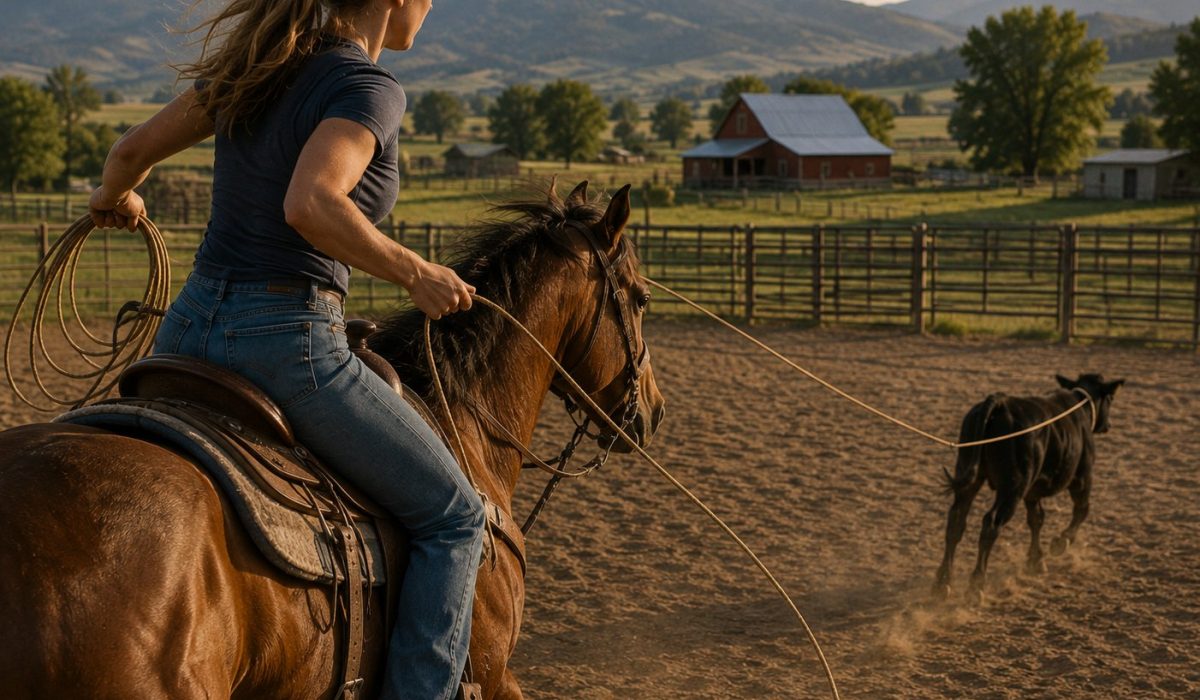
By high school she had become an accomplished rider, although accomplishment did not make the work surrounding it disappear. Weekends could begin before sunrise, especially when there was a competition or training session ahead. There were long hours in barns filled with the smells of hay, leather, dust, and horses, and there were mornings when the air was cold enough that her hands complained while she worked with buckles and straps. She accepted all of it because the work and the pleasure had never seemed like separate things.
Competition brought a different kind of excitement. There was preparation and waiting, the awareness of other riders and horses, and then the moment when everything narrowed to what was happening between Laura and the animal beneath her. What looked effortless from outside rarely was. A good ride rested on dozens of things practiced so often that neither horse nor rider seemed to be thinking about them anymore.
Laura knew how much work lay beneath that appearance because she had done the work. She also knew that trust could disappear much faster than it could be created. You couldn't demand it from a horse simply because you were sitting in the saddle. It accumulated through ordinary encounters—the way she approached, the steadiness of her hands, the consistency of what she asked, and whether she remained calm when something unexpected happened. There was no single afternoon when Laura could have said that a particular horse trusted her. One day she simply realized that it did.
Years later, she might have found other meanings in what the horses had taught her. There would be people and decisions more complicated than anything she encountered in a corral, and she would discover that patience and trust mattered well beyond the barn. But those were conclusions for an older Laura. The girl riding through high school wasn't collecting lessons for some future life. She wasn't thinking about careers or relationships or trying to turn an afternoon on horseback into a metaphor.
She wanted to ride.
That was enough reason to saddle a horse.
On some evenings, after the work was finished, Laura would remain outside while the light faded over the pasture. A horse might stand nearby grazing, moving a few steps at a time through the grass, apparently unconcerned about whether Laura stayed or went. She could hear the tearing of grass and the occasional movement of hooves against the ground. The barn behind her had become quieter. Whatever homework waited at home could wait a little longer.
College applications had not yet arrived. Career choices were still distant enough to belong to other people, and the larger questions that would eventually occupy so much of her attention had not yet found her.
For the moment there was nowhere else she needed to be. Laura stood beside the pasture in the fading light, watching the horse graze, already thinking about when she could ride again.
Posted in the-river by Geoff Stevens