
The River-Chapter 9
The Leaving
The day finally arrived with far less ceremony than Laura had imagined.
For months, college had existed mostly as an idea represented by brochures, application forms, acceptance letters, and conversations around the dinner table. There had always been another form to complete or another decision that could be postponed until later. Then, almost without warning, later became now, and the bedroom that had always been hers was filled with cardboard boxes waiting to be carried to the family car.
She had accumulated more than she realized. Clothes were easy enough, and books could be stacked wherever there was room, but other things were harder to classify. There were photographs she hadn't looked at in years but suddenly couldn't imagine leaving behind, small objects whose importance would have been difficult to explain to anyone else, and things she packed simply because they had always been in her room. By the time she finished, the boxes seemed to contain an odd inventory of the person she had been rather than everything the person she was becoming might need.
Leaving also involved goodbyes she hadn't anticipated.
Early that morning Laura walked out to the barn. The familiar smells of hay, leather, dust, and horses met her before she was fully through the door, and for a moment nothing seemed different. The horses were waiting for their morning feed with the same practical interest they showed every other morning. One looked up when she approached and then returned to eating, apparently unimpressed by the significance Laura had assigned to the day.
She found that reassuring.
She moved through the barn without hurrying, touching familiar things as she passed them. She had spent so many hours there that she knew the place almost without looking: where the tack belonged, which latch needed to be lifted slightly before it would close, which horse would turn its head when she approached. She stopped beside one of them and ran her hand along its neck.
The horse continued chewing.
“You could at least pretend you're going to miss me,” she said.
An ear turned briefly in her direction.
Laura decided that would have to do.
She stayed longer than she normally would have, not because she was reconsidering college but because she knew that when she came back, even if the barn looked exactly the same, something would have changed. She would be visiting from somewhere else. It was a distinction she could understand without knowing yet what it would feel like.
Back inside the house, the piano stood in the living room where it had stood through years of lessons, scales, recitals, arguments, and practice sessions she had occasionally approached with considerably less enthusiasm than her teacher might have preferred. Laura sat on the bench and rested her fingers on the keys without opening any music.
For much of her childhood, piano had seemed to compete with everything else she wanted to do. There had been afternoons when the horses were outside and she was inside practicing, days when friends were waiting and a lesson came first, and long stretches when she had been unable to understand why adults were so convinced that persistence was good for her. Somewhere along the way the argument had ended without her noticing. Music had simply become hers.
She played for a few minutes, not anything she was preparing for a recital and not particularly well at first. There was no teacher listening and no reason to start again when she missed a note. She played because she wanted to hear the piano before she left.
When she stopped, the house seemed unusually quiet.
The family car was loaded after breakfast. Her father found ways to fit boxes into spaces Laura would have considered too small, rearranging them until the trunk finally closed. Her mother asked twice whether she had remembered things Laura was fairly certain she had packed, and once about something Laura had never intended to take.
Eventually there was nothing left to carry.
Laura stood for a moment looking at the house. She had expected leaving to produce some unmistakable sensation—a dividing line between childhood and whatever came next—but the house looked exactly as it had the day before. Nothing about the front door or the yard suggested that she was doing anything more consequential than going somewhere for the afternoon.
Then she got into the car.
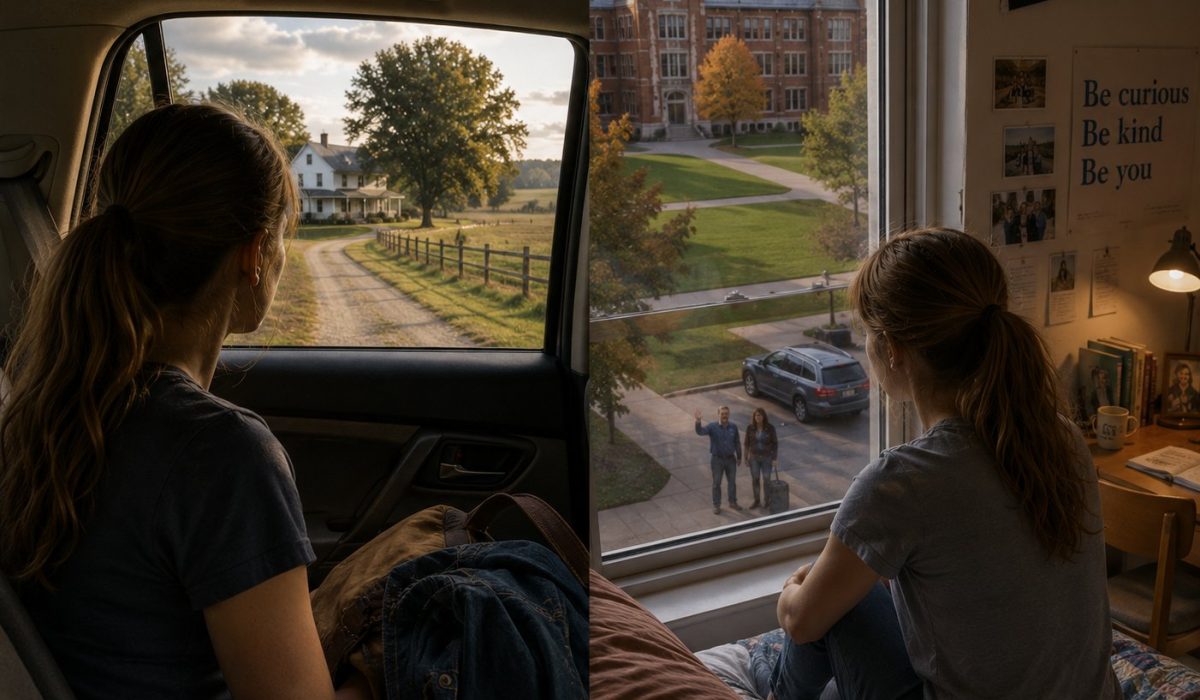
The drive to campus was familiar for part of the way and unfamiliar after that. Conversation came and went without anyone trying very hard to sustain it. Her father commented on traffic and pointed out a route that might be better when she drove home herself. Her mother mentioned something about laundry, then seemed to realize she had already mentioned it and stopped.
Laura watched the landscape pass outside the window. She was excited, certainly, but excitement turned out to have room for other things inside it. She thought about the barn and wondered what the horses were doing, though she knew perfectly well what they were doing. She thought about the piano and the bedroom with fewer things in it. She wondered whether her mother would walk past the open door that evening and notice the difference.
Mostly, though, she wondered about the place ahead.
Campus was larger and considerably more confusing than it had appeared during their earlier visit. Cars moved slowly through crowded streets while families unloaded suitcases, boxes, lamps, stereos, bedding, and quantities of belongings that suggested some students had misunderstood the meaning of leaving home. Young men and women stood on sidewalks holding maps and trying not to look as lost as they were. Parents gave directions despite having no better idea where they were going.
Laura found this encouraging. Apparently nobody knew what they were doing.
Her own room was smaller than she remembered from the tour. Once the boxes were inside, it became smaller still. She and her parents spent the next hour arranging things, discovering that furniture which looked movable often wasn't and that two people could have surprisingly different opinions about where a desk lamp belonged.
Eventually there was nothing left for her parents to help with.
That was the part none of them had quite planned.
Her mother hugged her first and held on a little longer than usual. Her father reminded her that she could call anytime, a statement so obvious that Laura understood it wasn't really about the telephone. There were a few more instructions, none of which she would remember clearly afterward, and then they walked together to the car.
Laura stood on the sidewalk while they drove away. Her mother turned once and waved through the window. Laura waved back until the car disappeared among the others leaving campus.
For a few seconds she remained where she was.
Then someone behind her said, “Excuse me,” because she was standing in the middle of the sidewalk.
Laura moved.
By evening she had unpacked enough to make the room look temporarily inhabited. Books went on a shelf, clothes into drawers, and a framed photograph of her family onto the desk. There were still boxes on the floor, but she decided they could wait. Through the window she could see students crossing the courtyard, some already moving in groups as though friendships had been established while she wasn't paying attention. Somewhere nearby music was playing. A door opened and closed down the hall, followed by laughter from people whose names she did not yet know.
Tomorrow she would attend her first college class.
The thought carried more weight now than it had when college was something discussed at the dinner table. Tomorrow morning no one at home would wake her. No horse would be waiting for her at the barn. No familiar sequence of family sounds would tell her where she was or what came next. She would decide when to get up, where to eat, which route to take across campus, and whether she had remembered everything she needed.
It was freedom, although sitting alone in the room that evening Laura began to understand that freedom was not quite the same thing as having nothing to answer to. If anything, there was suddenly no one else to blame for whatever she did next.
She smiled at that.
Outside, students continued crossing the courtyard as daylight faded from the buildings. Laura didn't know any of them yet. She didn't know which classrooms would become familiar, which professors she would remember years later, or which people now walking anonymously below her window might eventually become part of her life. For once she didn't feel any particular need to know.
She had left home that morning and arrived somewhere new. That was enough change for one day.
Laura got up from the window and began opening another box.
Posted in the-river by Geoff Stevens