
The River-Chapter 11
Finding Her Place
By the end of Laura's first week of college, she had begun to suspect that nearly everyone on campus was pretending to know more than they actually did.
During the first few days this had not been obvious. Some students spoke with such confidence about professors, majors, and buildings that Laura assumed they had been given information she had somehow missed. Others walked rapidly across campus with maps folded into their back pockets, which made them appear to know where they were going until one of them stopped at an intersection, unfolded the map, and turned it several times trying to determine which direction was north.
Laura found this reassuring.
Her own campus map had already developed soft creases from repeated use. She had learned the route from the dormitory to the cafeteria and could find two of her classrooms without assistance. The third was in a building whose entrances seemed deliberately designed to confuse freshmen. On her second attempt she followed another student who was walking purposefully toward it, only to discover that he was lost too.
“I thought you knew where you were going,” she told him.
“I thought you knew.”
They stood together looking at the map.
“That seems like a flaw in the system,” Laura said.
Eventually they found the building.
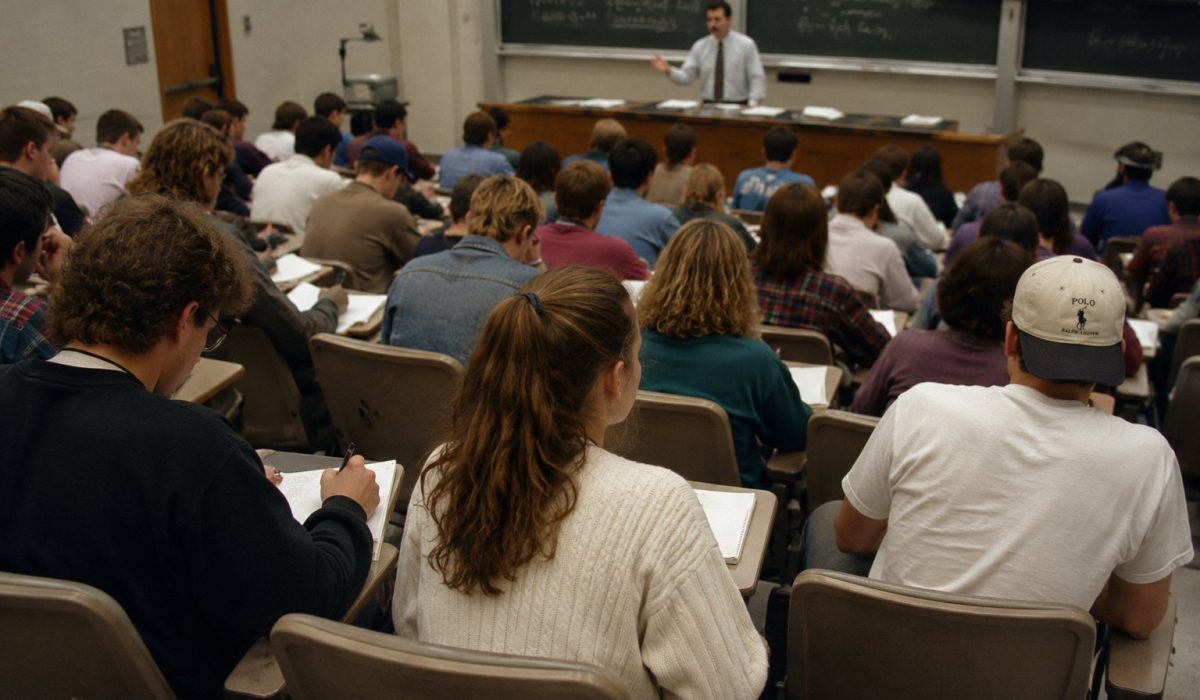
Orientation meetings filled much of the first week. Laura sat in rooms with students whose names she tried to remember while people at the front explained registration procedures, academic requirements, campus rules, and services she was assured would become important later. Introductions followed a predictable pattern: name, hometown, intended major. By the fourth or fifth meeting Laura had heard so many versions that she sometimes recognized a face without remembering anything attached to it.
She discovered that asking another person the same question twice was usually less embarrassing than pretending to remember the answer.
Conversation had always come fairly easily to her when there was something practical to talk about. College provided an almost unlimited supply of practical questions. Where are you from? What are you studying? Do you know where the science building is? Have you eaten yet? Those questions led naturally to others, and Laura soon realized that most people were relieved when someone else began.
It wasn't that she was unusually fearless. She missed home, especially at odd moments when something reminded her of the ranch, and she occasionally walked into a room where everyone seemed to know one another and had to resist the impulse to leave again. But she had spent enough time around horses to know that nervousness was not improved by standing still and concentrating on it. Usually it was easier to walk across the room and say hello.
Gradually, the campus began filling with recognizable people. There was a girl from Oregon she kept seeing in chemistry, someone down the hall who played country music loudly enough that Laura knew her musical preferences before she knew her name, and a student from Arizona who had never seen snow and regarded the possibility with considerably more enthusiasm than Laura thought winter deserved. She met another student who had grown up around horses, and the discovery immediately gave them twenty minutes of conversation without either having to think of anything else to say.
The girls she had met in the cafeteria on her first night appeared again too. At first their meetings were accidental. Then someone suggested dinner at a particular time, and accidental encounters began becoming arrangements. One evening dinner stretched into coffee, and coffee stretched into conversation in the dormitory until much later than Laura had intended to stay awake.
Friendship, she discovered, didn't necessarily announce itself. People simply kept appearing.
College also gave Laura a kind of freedom she had anticipated without entirely understanding. At home, the structure of the day had existed whether she wanted it or not. Animals needed attention. Meals happened at roughly predictable times. Her parents knew when she left and generally had some idea when she would return. Piano lessons, schoolwork, chores, and riding all occupied places in a schedule that had been built over years.
At college, nobody seemed particularly concerned about what she did between classes. No one reminded her to study or asked whether an assignment was finished. She could skip breakfast, eat dinner at an unreasonable hour, or stay awake talking until two in the morning. If she slept through a class, no one was likely to appear beside her bed and inquire about her intentions.
For the first few days, this seemed extraordinary.
Then Laura noticed that an eight o'clock class remained at eight o'clock regardless of what she had done the night before.
She learned this after one of those late conversations in the dormitory. When her alarm sounded the next morning, she opened her eyes with the distinct impression that something had gone badly wrong with time. She considered not getting up. Nobody would know.
Then she remembered that she would know, which was irritating.
She went to class.
The habits she had brought from home turned out to be more useful than she had expected. Years of caring for animals had made getting up when she didn't particularly want to seem less remarkable. Piano had taught her that waiting until she felt inspired was not a dependable method of preparation. School and competition had taught her to finish things before the last possible moment, although college would occasionally test how firmly she intended to maintain that principle.
She wasn't rigid about it. There were evenings when conversation mattered more than another hour with a textbook, and afternoons when someone suggested doing something more interesting than what Laura had planned. She began learning the difference between neglecting a responsibility and deciding that it could wait.
That distinction felt important.
By the end of the first month, the campus had become smaller. Buildings that had seemed scattered randomly across an enormous landscape now existed in relation to one another. Laura had favorite routes between classes and knew which cafeteria line moved fastest. She knew where to sit in the library when she actually wanted to work and where to sit when she was willing to be interrupted. She no longer carried the campus map.
Her room was changing too. The photographs she had placed on the desk during that first afternoon no longer looked like an attempt to make a temporary room feel familiar. Papers accumulated beside them. Books leaned against one another on the shelf. Her roommate's belongings mixed with hers in the ordinary way that happens when two people stop thinking constantly about which half of a room belongs to whom.
The photograph of the horse still sat on Laura's desk.
She looked at it sometimes and missed the barn with a physical immediacy that surprised her—the smell of hay, the weight of a saddle, the warmth of a horse beneath her hand. Missing it did not make her want to leave college. That was another distinction she was beginning to understand. She could want what she had left and still want what she was finding.
One afternoon Laura crossed the campus on her way back from class and passed a group of students studying a map near the same intersection where she had been lost during her first week.
One of them looked up. “Do you know where the science building is?”
Laura did.
She pointed across the quad and explained which walkway to take and which entrance was easiest to find. The student thanked her, and Laura continued toward the dormitory without thinking much about the exchange.
A few steps later, she smiled.
The campus wasn't home. The ranch remained home in a way this place could not yet duplicate, and perhaps never would.
But she knew where the science building was.
For now, that seemed like a pretty good start.
Posted in the-river by Geoff Stevens