
The River-Chapter 18
Where the River Divides
Winter had begun to loosen its grip on the valley, though spring had not yet gathered enough confidence to announce itself. Patches of snow lingered in the shadows beneath cedar and fir, while the south-facing hillsides had begun to show the first uncertain green. March had always seemed to Laura a month caught between intentions. Mornings still required gloves, but by afternoon she might leave them on the seat of the truck and forget they existed.
Classes had stopped for spring break, and after the schedules of the previous months she found herself with something that had become surprisingly rare: a day that belonged entirely to her.
She had gone home for the break, but that morning she left the ranch without deciding exactly where she was going. Her mother had asked whether she'd be back for dinner, and Laura had said she thought so, which seemed like enough of a plan. She drove north on the two-lane road that followed the river, leaving the radio off and the window cracked just enough to let in the cold air. Barns gradually gave way to open meadows, and fences wandered across rolling pastures before disappearing among the pines.
Driving without a destination had once seemed irresponsible to her. College had cured her of that, at least temporarily. Scott had helped. Their Saturday afternoon in his unreliable pickup had demonstrated that an absence of planning could occasionally produce a perfectly good day, though Laura wasn't yet prepared to make a philosophy of it.
She passed a gravel turnout she remembered seeing on other drives, went another quarter mile, then changed her mind and turned around.
A narrow trail began beyond the turnout and followed the river through cottonwoods whose bare branches made dark patterns against the pale sky. Laura zipped her jacket and started walking. Last autumn the trees would have been yellow. Now they stood waiting for whatever came next, apparently in no hurry to pretend winter was over.
For the first half hour she thought about very little. That was one of the things she liked about walking. Her mind could occupy itself if it wanted to, but the body had simpler concerns: the uneven ground, a muddy patch beside the trail, the warmth that gradually made her unzip the jacket she had so recently zipped. The river moved beside her, swollen somewhat by early snowmelt, carrying twigs and dead leaves left from the previous season.
Eventually, as it usually did, her mind returned to the questions she had brought with her.
The conversation with her father at Christmas had helped, though not in the way she had expected. He had refused to solve anything for her. She could study business and continue with music, he had said in effect, and there was no particular reason a twenty-year-old woman should be able to describe the rest of her life with the precision of a course catalog.
Laura agreed with him.
Mostly.
The trouble was that college was organized around choices. A student selected a major, chose courses, satisfied requirements, and moved steadily toward graduation. Forms contained boxes. Advisers produced lists. Eventually employers would want to know what she could do. There was something reassuring about all that structure, but it also encouraged the belief that every choice eliminated something else.
Music complicated the matter because it had never felt like a choice.
She had been playing almost as long as she could remember. Her mother's lessons had become her own practice, and the piano had followed her from childhood into college without Laura ever deciding that it should. She had earned scholarships because of it. She taught younger students. She practiced every Thursday afternoon and often on other days because she wanted to. When Scott had stood outside the practice room listening to her, she had seen her music briefly through someone else's eyes and understood how much of her life it represented.
Business was different. She had chosen it because it seemed sensible and then had made the inconvenient discovery that she actually liked it.
Laura smiled as she walked.
It would have been much simpler if one of them had disappointed her.
The trail moved away from the river for a while, climbing through a stand of pine. When it descended again, the trees opened onto a broad bend she had never seen from the road. Laura stopped.
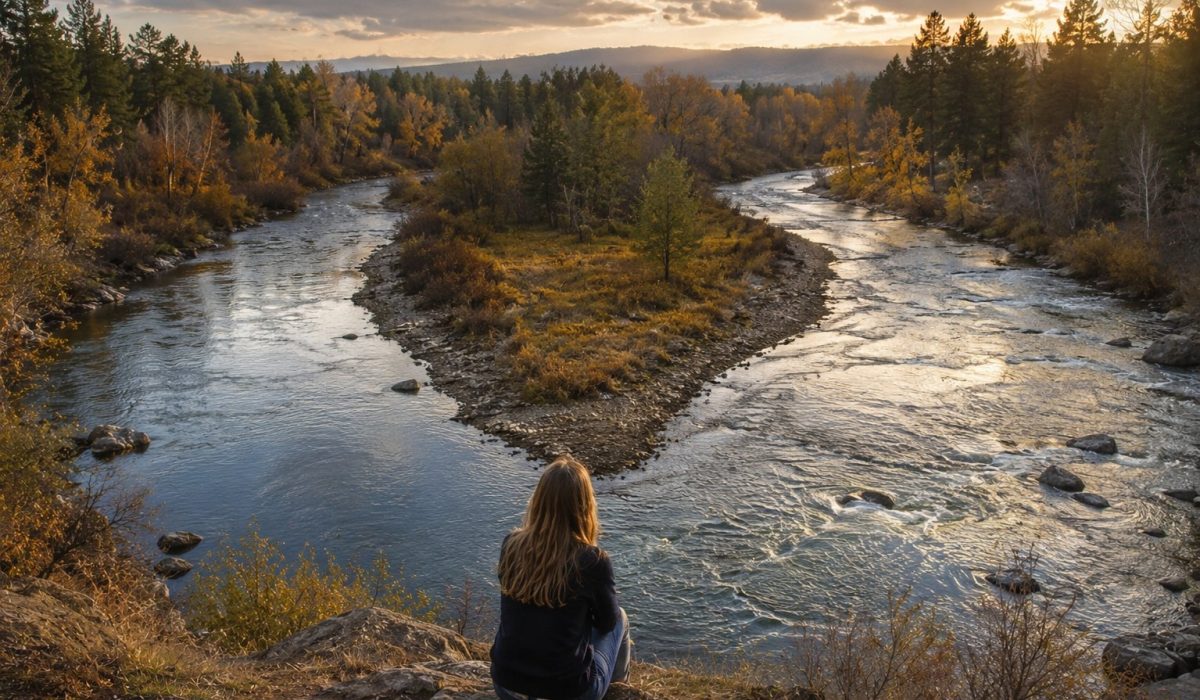
A long, low island lay in the middle of the river. The current divided around it, and the two channels could hardly have looked more different. On Laura's side the water moved broadly and quietly, dark beneath the trees. Across the island the other channel narrowed against shelves of basalt and broke into white water before disappearing around the bend.
She walked closer to the bank and found a fallen log dry enough to sit on.
For a while she did nothing more than watch.
A branch came downstream, turning slowly as it approached the island. Laura followed it with her eyes, curious which channel would take it. Near the head of the island it spun once in the confused water and then moved into the quieter channel, where the current carried it steadily out of sight.
She found herself wondering why it had gone that way.
The foolishness of the question made her smile. The branch hadn't chosen anything. Water, depth, current, the shape of the riverbed—forces she couldn't see from where she sat—had determined its course.
Human lives were not quite that simple. Laura knew that much. She had choices the branch did not have, and she was responsible for making them. Still, sitting there, she began to wonder whether she had been giving individual choices more permanence than they deserved.
For months she had imagined music and business as two futures standing opposite one another. Music led toward teaching, performing, perhaps the domestic life she had described to Scott in the practice room—the life she suspected her parents had once pictured for her. Business led somewhere less familiar, toward organizations and problems and work she could not yet name. She kept trying to see far enough down either route to know which one was correct.
From the log beside the river, that effort suddenly seemed a little unreasonable.
Laura got up and walked farther along the bank.
The island was longer than she had first thought. For several hundred yards the two channels remained separate. One stayed smooth while the other announced itself through the rocks. Then the island narrowed. Beyond it, partly obscured by cottonwoods, the channels came together.
Laura stopped again.
The river had divided, but it had not become two rivers.
She stood with her hands in her jacket pockets, looking downstream.
The thought was appealing, perhaps too appealing. Rivers made convenient metaphors because they could be persuaded to mean almost anything if a person stared at them long enough. Her father would probably have pointed that out. Scott would have made a joke about branches having career plans.
Still, there was something in what she was seeing that she hadn't quite understood before.
She had been treating music as though it could justify all the years she had given it only by becoming her profession. If she eventually earned her living somewhere else, then perhaps those lessons, recitals, competitions, scholarships, and thousands of hours of practice would somehow become preparation for a life she had declined to live.
Standing beside the divided river, Laura could no longer see it that way.
Music had already given her more than an occupation could account for. It had taught her to stay with difficult work after the first enthusiasm disappeared. It had taught her that repetition wasn't the opposite of creativity but often the way one reached it. She knew how to listen, how to work alone, how to prepare for the moment when preparation had to give way to performance. She had learned that a mistake in the middle of a piece did not permit you to stop and begin life again from the first measure. You continued.
None of that would disappear if her paycheck someday came from somewhere other than a piano.
She thought of her mother then, not as the woman who might have imagined Laura teaching piano to children of her own, but as the woman who had first placed Laura's small hands over a keyboard. Perhaps her mother had possessed ambitions for her. Most parents did. But Laura wondered if she had confused her mother's love of music with an expectation that Laura's life must reproduce it.
She would have to ask her someday.
The possibility that she could continue studying business without abandoning music seemed obvious once she allowed herself to consider it. In practical terms, nothing had even changed. She was already doing both. On Monday she could discuss organizations or accounting; on Thursday she could walk into the practice room and spend two hours at the piano. One activity had not diminished the other. If anything, moving between them had begun to make each more interesting.
Laura sat again, this time closer to where the two channels rejoined.
She thought about telling Scott what she had decided and then realized she hadn't decided anything.
That made her laugh.
After months of worrying over a decision, she had apparently reached the conclusion that she didn't need to make one.
Scott would enjoy that.
The sun had moved lower while she sat there, and the temperature was beginning to fall. Laura pulled her jacket closed. She had promised only that she thought she would be home for dinner, but her mother would interpret that with considerably more precision once darkness approached.
She started back along the trail.
At the place where she had first seen the island, she stopped once more. From this angle the division was obvious: quiet water to one side, white water to the other. Farther downstream, the distinction disappeared.
Laura resisted the temptation to make more of it than she should. A river was not a life, and water did not have to decide what it wanted to become. People did. There would be choices ahead of her, some of them important, and eventually she would have to make them without knowing where they led.
But perhaps choosing one thing did not always require surrendering everything that had come before it.
That seemed enough to carry back with her.
By the time she reached the turnout, her shoes were muddy and she had worked up enough warmth to unzip her jacket again. She stood beside the truck brushing dried mud from one shoe against the other and realized that she was hungry.
Whatever else remained unresolved, dinner had become quite clear.
Laura climbed into the truck and started toward home. The river appeared occasionally through the trees beside the road and then disappeared again as the road curved away from it.
She no longer needed to see it to know it was there.
Posted in the-river by Geoff Stevens