
Focus Man: The Gathering
Chapter 17
For years, whenever someone asked how he and Claire had met, Focus Man gave them the simplest version of the story.
"A friend invited me to a party."
It was true, as far as it went.
Most stories people tell about their own lives are true in that fashion. They contain the important facts while quietly discarding nearly everything that gave those facts meaning. Memory kept what it wanted. Menus disappeared. Weather disappeared. The arrangement of furniture, the names of people standing nearby, the song playing in another room—all could vanish while a single expression on someone's face remained intact for forty years.
What Focus Man remembered about that Friday evening was surprisingly little.
One of the partners at the software company had invited everyone to his house. There would be food, a few spouses and friends, music of some kind. The invitation had circulated casually through the office late in the week, and Focus Man had responded in the manner he usually responded to social invitations.
He intended to decide later.
By Friday afternoon he was still deciding.
The startup had begun changing him, although he wouldn't have described it that way then. At the corporation, friendship and work had occupied neighboring but distinct territories. People might like one another, sometimes very much, but the organization itself established the relationships. There were departments, reporting structures, titles, conference rooms, scheduled lunches.
The startup was different.
There were too few people for those boundaries to hold. Everyone worked with everyone else. A technical problem begun by one person might end with four people gathered around the same desk. Someone went out for sandwiches and returned with six. A printer stopped working and three software developers attempted to repair it despite considerable evidence that none of them understood printers.
Focus Man had learned not to ask how that particular repair was progressing.
The people had become friends almost without deciding to.
That made declining the party harder.
"You're coming tonight, right?" Peter asked late Friday afternoon.
"I haven't decided."
Peter stared at him.
"You've been deciding since Wednesday."
"I've been busy."
"You're deciding whether to drive twelve miles and eat somebody else's food."
"When you put it that way, it sounds simpler."
"It is simpler."
Focus Man looked back at his screen.
Peter waited.
"You know," he finally said, "most people don't require a decision matrix for a party."
"I don't have a decision matrix."
"You thought about one."
Focus Man smiled despite himself.
"Seven?"
"Seven-ish. That's how parties work."
Focus Man disliked the ish almost as much as Peter knew he would.
Somehow he went.
Years later, he would sometimes wonder how many of the consequential moments in a life begin with reluctant decisions made for reasons no one can remember.
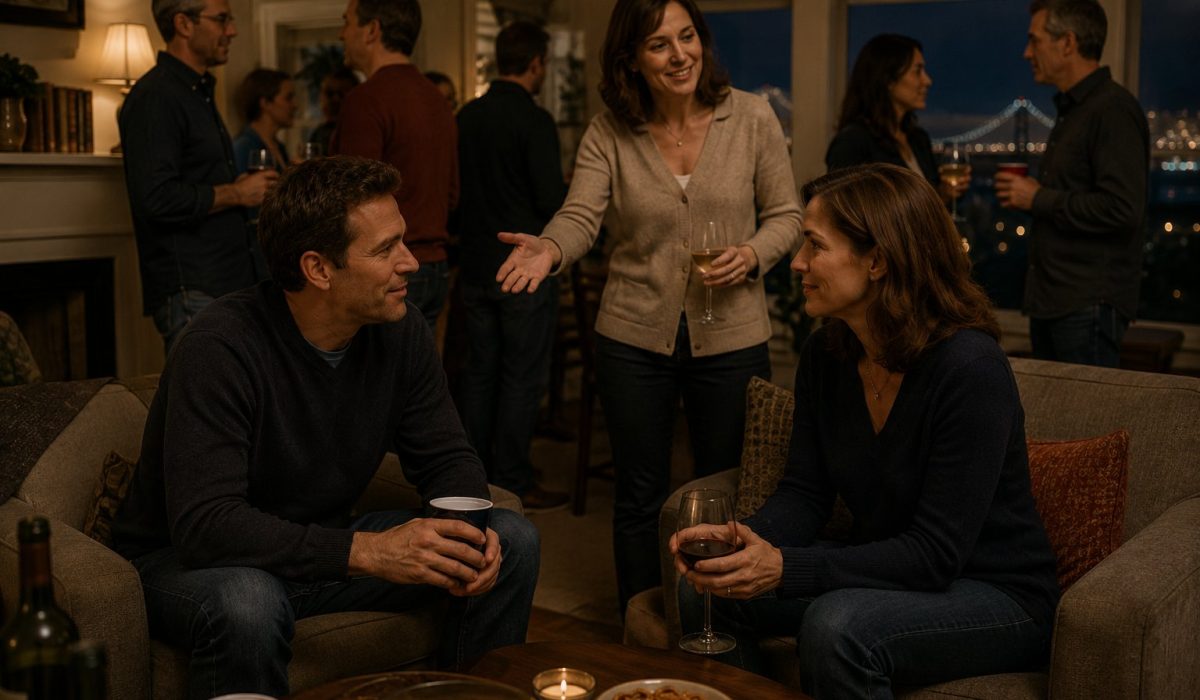
The house stood in the hills overlooking the bay, its windows glowing warmly against the evening. Cars already lined both sides of the street when he arrived. He found a space farther downhill and walked back toward the house carrying a bottle of wine Peter had assured him was unnecessary.
Inside, the rooms were already full enough to make him briefly reconsider the wisdom of coming.
People stood in loose groups with drinks and paper plates, moving easily between conversations. Music played somewhere beneath the larger sound of voices. He recognized his coworkers immediately and several of their spouses, and that helped. He accepted food, talked with Peter for a while, listened to an argument about whether one of their clients would ever understand what the software was supposed to do, and gradually found himself near the edge of the living room.
That was where he usually ended up at parties.
He wasn't unhappy there.
This was something people often misunderstood about introverts. Being quiet at a gathering didn't necessarily mean wanting to escape it. Focus Man liked watching people. He liked listening to conversations without feeling obliged to improve them. What exhausted him was the constant movement from one shallow exchange to another—the repeated introductions, occupations, neighborhoods, mutual acquaintances, all the conversational scaffolding people erected before deciding whether there was anything they actually wanted to say to one another.
Across the room stood a woman he hadn't seen before.
He noticed her without attaching much significance to the fact.
She was attractive, certainly, but there were attractive women in the room. What caught his attention was that she seemed to be attending the party much as he was. She stood with two other people near the bookcase, listening more than speaking. When the conversation around her dissolved and the others moved away, she didn't immediately search for another group to join. She simply remained where she was, holding a coffee cup and looking perfectly comfortable with the temporary absence of conversation.
Focus Man looked away.
A few minutes later his partner's wife appeared beside him.
"I've been watching you."
"That sounds ominous."
"It's worse than you think."
She nodded toward the other side of the room.
"I've been watching her too."
Focus Man followed her glance.
The woman with the coffee cup was now studying a photograph on the bookshelf.
"Why?"
"Because you're attending the same party from opposite corners."
"I'm talking to people."
"You were talking to people."
"So was she."
"Exactly."
He understood too late what she intended.
"No."
She smiled.
"I didn't ask you anything."
"You're about to."
"I don't have to."
Before he could stop her—which, in retrospect, he probably could have done with considerably more effort than he made—she crossed the room.
She returned with the woman beside her.
"Claire, this is the man I was telling you about."
Focus Man looked at his hostess.
"You were telling people about me?"
"Only the interesting ones."
Claire laughed.
Their hostess made the introductions, remained just long enough to ensure neither could escape gracefully, and then disappeared into the kitchen.
For several seconds they stood holding their coffee.
Claire looked toward the kitchen.
"Does she do this often?"
"I don't know. I've never been on this end of it."
"She told me there was someone I should meet."
"She told me nothing."
"Then apparently I'm the one who received advance warning."
That was how it began.
Not with recognition.
Not with attraction so immediate that the room disappeared around them.
With amusement.
They talked first about the people they both knew, which led naturally to the software company. Claire worked for a large healthcare organization in San Francisco, and when Focus Man explained that he had recently left a corporation for a startup, she asked the question almost everyone else had avoided.
"Why?"
He gave her the practical answer first. The work was interesting. The company was small. He wanted to be closer to the technical problems again.
Claire listened.
"No," she said when he finished. "I understand all that. I meant why did you leave?"
He looked at her.
"I just told you."
"You told me why the new job appealed to you. That's different."
Focus Man considered this.
Most people who asked about the change wanted to know whether the startup was promising, whether he had received stock, whether the salary was better, whether he worried about security. Claire seemed uninterested in any of those things.
"I suppose I missed making things."
"What were you doing before?"
"Managing people who made things."
"And you didn't like managing?"
"I was good at it."
Claire smiled.
"That's not what I asked."
He laughed.
It had been a long time since a stranger had caught him answering the question he preferred rather than the one she had actually asked.
"No," he said. "I didn't dislike it. That's what made leaving difficult."
She waited.
He found himself telling her about the empty office late one evening, about spending an entire day in meetings and then losing two hours happily tracing a software problem everyone else had gone home and forgotten. He told her about Peter's disastrous recruiting pitch and the office over the print shop. He even told her about the colleague who had informed him that leaving a secure corporation for twelve people who couldn't repair their own printer was evidence of questionable judgment.
Claire laughed.
"Was he right?"
"Probably."
"And you went anyway."
"I did."
"Are you glad?"
Focus Man looked across the room toward Peter, who at that moment was explaining something with enough hand gestures to endanger the drink of the person standing beside him.
"Ask me in five years."
Claire followed his gaze.
"I think you already know."
Perhaps he did.
The conversation wandered after that, although wandering was not the same as becoming superficial. Claire told him about her own work. She was less interested in describing her position than in describing people—an employee who had surprised everyone by becoming an excellent manager, a physician who could explain frightening things to patients without frightening them further, a woman nearing retirement who knew more about how the organization actually functioned than most of its executives.
Focus Man noticed this about her.
He described systems.
Claire described people.
Neither seemed bored by the other.
At some point they moved away from the center of the room because the music had grown louder. Someone replenished the food in the kitchen. Guests arrived whom neither noticed and others departed without saying goodbye to them.
The conversation continued.
He learned that Claire liked the ocean better in winter, when beaches were nearly empty. She learned that he could become unreasonably interested in why a traffic signal had been timed badly. He discovered that she read novels slowly because she disliked leaving characters she had come to care about. She discovered that he sometimes reread the same paragraph three times because a sentence bothered him and he wanted to understand why.
"That sounds exhausting," she said.
"It isn't."
"For you."
"Apparently not."
She smiled.
There was no performance between them.
That was what he remembered most clearly.
Neither seemed to be trying to impress the other. They were simply curious, and curiosity, when returned in equal measure, could carry a conversation a surprisingly long distance.
Eventually Peter appeared beside them.
"There you are."
Focus Man looked around.
"I've been here all evening."
"No, you've been missing for two hours."
Claire checked her watch.
He did the same.
Peter smiled.
"Apparently the experiment worked."
"What experiment?"
Peter looked toward their hostess in the kitchen.
"Never mind."
Then he disappeared before either could question him.
Claire laughed.
"I think we've been managed."
Focus Man considered that.
"I don't like being managed."
"Neither do I."
They looked toward the kitchen.
Their hostess noticed them and raised her glass.
Neither waved back.
That made them laugh harder.
When the evening finally ended, they joined everyone else near the front door searching among coats and jackets. Focus Man couldn't remember later whether they exchanged telephone numbers that night or whether someone arranged for them to meet again. That detail, oddly enough, disappeared with the food and the music.
What he remembered was standing on the sidewalk beside Claire.
The bay below them was mostly darkness broken by scattered lights. The night had turned cooler, and she pulled her coat more tightly around herself.
"I enjoyed talking with you," she said.
"So did I."
It was an ordinary thing to say.
They meant it.
He drove home thinking he hoped he would see her again.
Nothing more.
There was no certainty, no sense of destiny, no awareness that some great dividing line had just been crossed. If someone had asked him the following morning what had happened at the party, he probably would have said he'd met an interesting woman.
That was all the younger man knew.
Years later, sitting alone on the deck after the barbecue, he understood how inadequate that description had been.
The boys had gone home. Their basketball remained near the edge of the patio where one of them had abandoned it. Through the window he could see Claire moving around the kitchen, putting away the remnants of dinner. Earlier that afternoon she had taken the basketball from one of the boys, announced that they were all underestimating her, and made a shot that had produced considerably more celebration than the quality of the shot warranted.
Focus Man smiled at the memory.
Then he thought about that Friday gathering.
The conversation with Claire had become a marriage. It had become shared houses and difficult seasons, walks beside the ocean, ordinary disagreements, illnesses endured, decisions made together, quiet mornings when neither needed to speak. Somehow it had even become two boys who weren't theirs and yet had wandered deeply enough into their lives that Claire's improbable basketball shot mattered to everyone watching.
But now Focus Man could see farther upstream.
Before Claire there had been the gathering.
Before the gathering, the startup.
Before the startup, a resignation letter placed on a good man's desk.
He had thought he was changing jobs.
That was all.
The remarkable thing about a life, he had come to understand, was how rarely its important turns announced themselves. The great forks seldom arrived with signs explaining what waited down each road. More often there was only an invitation you nearly declined, a job you weren't certain you should take, a conversation you almost didn't have.
And sometimes an overly confident hostess who decided that two introverts had spent enough time on opposite sides of a room.
Focus Man watched Claire through the window.
She noticed him looking and lifted one hand.
He lifted his in return.
The younger man driving home from that party could not possibly have imagined her standing in that kitchen decades later.
Perhaps that was merciful.
Had he understood everything that depended upon the ordinary decisions of those years, he might have been too frightened to make any of them.
Instead, he had simply gone where the river carried him.
Only much later did he understand how many times he had almost missed the current.
Posted in focus-man by Geoff Stevens