
The River-Chapter 19
By the time she returned to campus, the trees along the river had begun showing the first unmistakable signs of spring. Cottonwood buds swelled at the ends of bare branches, and patches of green appeared along the muddy banks where snow had covered the ground only weeks before. The river itself ran higher now, carrying the mountain snow toward places she would never see.
Something in her had quieted during the break.
She had not chosen a career. She had not abandoned music. She had not solved the question that had occupied so much of the winter. Yet the urgency had disappeared. The afternoon beside the divided river had given her something more useful than an answer. It had given her permission to wait.
She returned to the piano because she loved playing it.
She returned to her business courses because she wanted to understand them.
For the moment, that was enough.
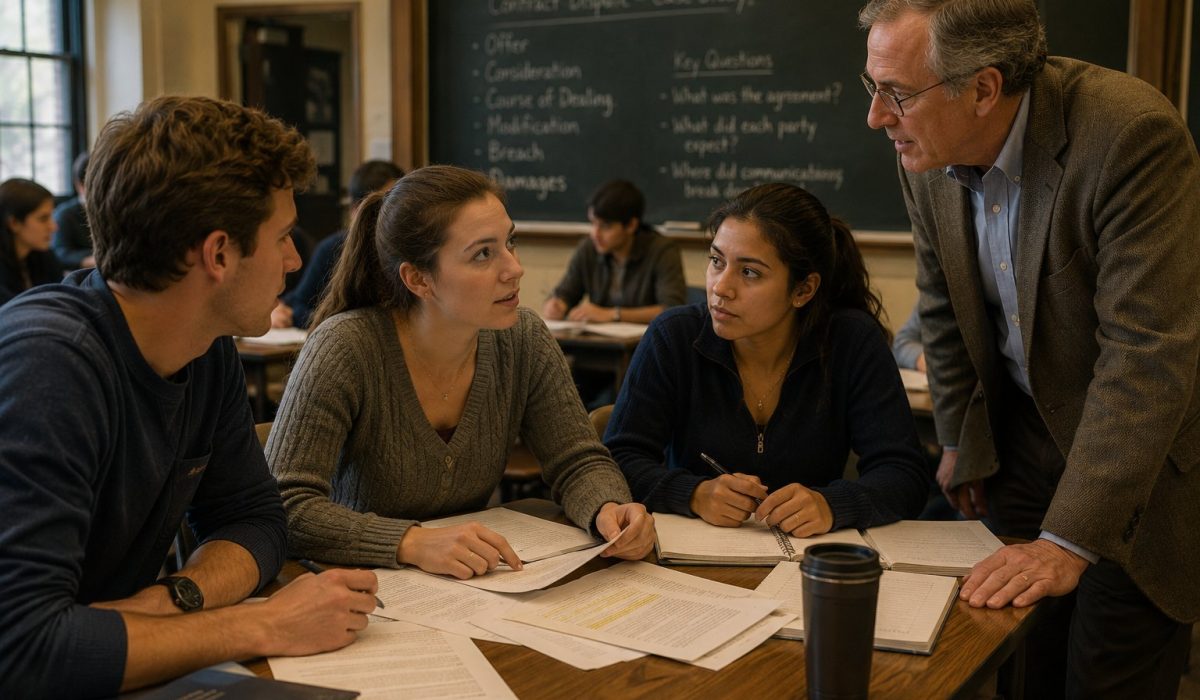
One of those courses met three afternoons a week in an older building near the center of campus. Business Law sounded considerably more impressive in the catalog than it looked in practice. The classroom contained several rows of scarred wooden desks, a chalkboard that never seemed completely clean, and windows that rattled whenever the spring wind came down from the mountains.
Professor Bennett taught without much interest in making the law sound grand. He was a compact man in his late fifties with thinning gray hair and the habit of removing his glasses whenever a student said something he found interesting. He had practiced law for nearly twenty years before discovering, as he once explained, that he preferred students to clients because students occasionally admitted when they were wrong.
No one knew whether he was joking.
That afternoon he handed out a case involving two small companies. One manufactured specialized agricultural equipment. The other supplied a component used in the machinery. A handshake agreement had gradually become a business relationship, the relationship had grown faster than either company expected, and eventually a disagreement arose over price, delivery schedules, and what each side believed the other had promised.
The case had already worked its way through a lower court.
Professor Bennett wasn't interested in the court's decision.
He wanted the class to decide what should have happened before anyone hired a lawyer.
He divided them into groups of three.
She found herself with Daniel Mercer, an accounting major who approached nearly every problem as though somewhere inside it was a number waiting to be discovered, and Lisa Moreno, who had already accepted a position with a large retailer after graduation and possessed the enviable certainty of someone who seemed to know exactly where her life was going.
Daniel read the case first.
"The supplier loses," he said.
Lisa looked up. "You've read half a page."
"I've read enough. They agreed to a price. Then their costs went up and they wanted more money. That's their problem."
She had been rereading a paragraph near the bottom of the second page.
"I'm not sure that's what happened."
Daniel leaned back in his chair. "They raised the price."
"Yes. But look at the dates."
He leaned forward again.
She placed her finger beside the paragraph.
"The original agreement was for six months. They kept doing business for almost three years. Production quadrupled during that time, but nobody renegotiated anything."
Lisa pulled the paper toward herself.
"So?"
"So maybe the price isn't the interesting part."
Daniel smiled. "In a contract dispute about price, you're saying price isn't interesting?"
"I'm saying they worked together for three years without ever making sure they still understood the same agreement."
For a moment neither of them answered.
Around the room, other groups had already become animated. Words like breach, damages, and liability traveled across the classroom.
Lisa reread the paragraph.
"All right," she said. "Suppose you're right. What does that change?"
She thought about it.
"Maybe nothing legally. I don't know. But these people weren't strangers. They built something together. One company depended on the other. Somewhere along the way they stopped talking about what each of them needed."
Daniel shook his head, though not dismissively.
"That's a very expensive communication problem."
"Exactly."
He laughed. "Which is why you put things in writing."
"Probably."
"Not probably. Definitely."
She smiled. "Fine. Definitely. But somebody still has to notice when the relationship has changed enough that the old agreement doesn't work anymore."
Lisa had been studying her.
"You aren't trying to decide who's right."
The observation surprised her.
"I suppose I'm not."
"What are you trying to decide?"
She looked again at the case.
"I want to know how they got here."
That was when she noticed Professor Bennett standing beside their desks.
She had no idea how long he had been listening.
Daniel straightened slightly. Lisa gave him the look students give professors when they suspect they may have just been caught saying something foolish.
Professor Bennett held out his hand.
"May I?"
She gave him their copy of the case.
He glanced at the paragraph she had marked.
"So," he said, "Mr. Mercer thinks we have a contract problem."
Daniel smiled. "We do have a contract problem."
"We most certainly do." Bennett turned toward Lisa. "And Ms. Moreno?"
"I think Daniel's probably right about the result. The supplier assumed a risk and then didn't like the consequences."
Bennett nodded.
Then he looked at her.
"And you?"
She hesitated. The answer that had seemed perfectly reasonable among the three of them now sounded oddly unsophisticated.
"I think by the time this became a contract problem, they'd already had a different problem for a long time."
"What kind?"
"They stopped understanding each other."
Bennett put his glasses on.
"That's not particularly legal."
"I know."
"Good."
She wasn't certain whether she had been complimented.
He handed the paper back.
"Law students have an unfortunate tendency to believe every disagreement begins when somebody files a complaint. Usually that's the least interesting part of the story."
Daniel folded his arms.
"So who's right?"
Bennett smiled.
"The judge."
A few students nearby laughed.
Daniel persisted. "That's not what I meant."
"I know exactly what you meant. You want me to tell you whether your analysis is correct so you can write it down and reproduce it on an examination."
"That would be helpful."
"It would also deprive you of an education."
This time Daniel laughed with everyone else.
Professor Bennett stayed beside their desks.
"The law will give you rules," he said. "Rules matter. Contracts matter. Words matter. But eventually someone has to understand what those words were intended to accomplish between actual human beings. That's where things become interesting."
He tapped the case lightly with one finger.
"Keep going."
Then he moved to the next group.
She watched him walk away.
Lisa leaned toward her.
"I think you just became his favorite."
"I think he just told me my answer wasn't legal."
"No," Daniel said. "He told you it wasn't legal and then spent five minutes explaining why he liked it."
They returned to the case, but something had changed. She found herself reading more slowly now, paying attention to details she would once have considered irrelevant. The owner of one company had known the other's family for years. The first orders had been informal because both sides trusted each other. As the businesses grew, decisions once made between two people over coffee had become responsibilities distributed among employees who knew little about the original relationship.
The dispute no longer seemed like a puzzle with a correct answer.
It seemed like a story.
And stories, she understood.
By the end of class their group had filled three pages with notes. Daniel had calculated the likely financial damages. Lisa had organized the contractual arguments. She had drawn a rough timeline showing where the relationship between the companies had begun to change.
Students gathered their books as Professor Bennett reminded them that their analysis was due Monday.
She slipped the case into her notebook and started toward the door with Daniel and Lisa.
They were halfway into the hallway when she heard her name.
Professor Bennett stood beside his desk gathering papers.
"Could you stay a minute?"
Daniel raised his eyebrows at her but wisely said nothing.
When the room had emptied, she walked back toward the front.
Professor Bennett continued arranging papers for a while, apparently in no hurry to explain why he had stopped her.
"You enjoy this class," he finally said.
It wasn't really a question.
"More than I expected."
"Why?"
She considered giving him the sort of answer students gave professors. The material was interesting. The lectures were engaging. She was learning a great deal.
None of those answers felt quite right.
"I like figuring out why people do what they do."
Bennett nodded as though confirming something to himself.
"That's a dangerous habit."
She smiled.
"So I've been told."
He put the last folder into his briefcase.
"What are you planning to do after graduation?"
That question again.
She had become accustomed to hearing it from relatives, professors, friends, and occasionally strangers who seemed to believe college seniors should carry their futures around like identification cards.
"Something in business, I think."
"You think?"
"I used to think music."
"And now?"
"Now I think music is something I'll always have. I'm just not sure it has to be how I earn a living."
Bennett studied her for a moment. Not critically. If anything, he seemed amused by something she couldn't see.
Then he picked up his briefcase.
"Have you ever considered law school?"
She stared at him.
"No."
He nodded once.
"You should."
That was all.
He walked toward the door, pausing to switch off the classroom lights as though he had suggested nothing more consequential than a book she might enjoy.
She followed him into the hallway.
Outside, students crossed the quad beneath a pale spring sky. Someone rode past on a bicycle. Two girls sat on the library steps sharing something from a paper bag. From an open window in the music building came the faint sound of a piano, scales rising and falling with patient repetition.
She stood there for a moment listening.
Law school.
The idea was so unexpected that she almost laughed.
Nothing about it belonged to the future she had been imagining.
She started across campus toward the river.
By the time she reached the bridge, she had already told herself Professor Bennett's remark meant very little. Professors said things. Students considered possibilities. Most possibilities disappeared.
Below her, the river moved swiftly with the spring runoff, carrying branches and winter debris beneath the bridge and around the bend.
She stopped and watched it for a while.
Then she continued toward home.
The question went with her.
Posted in the-river by Geoff Stevens