
Focus Man: The Resignation
Chapter 15
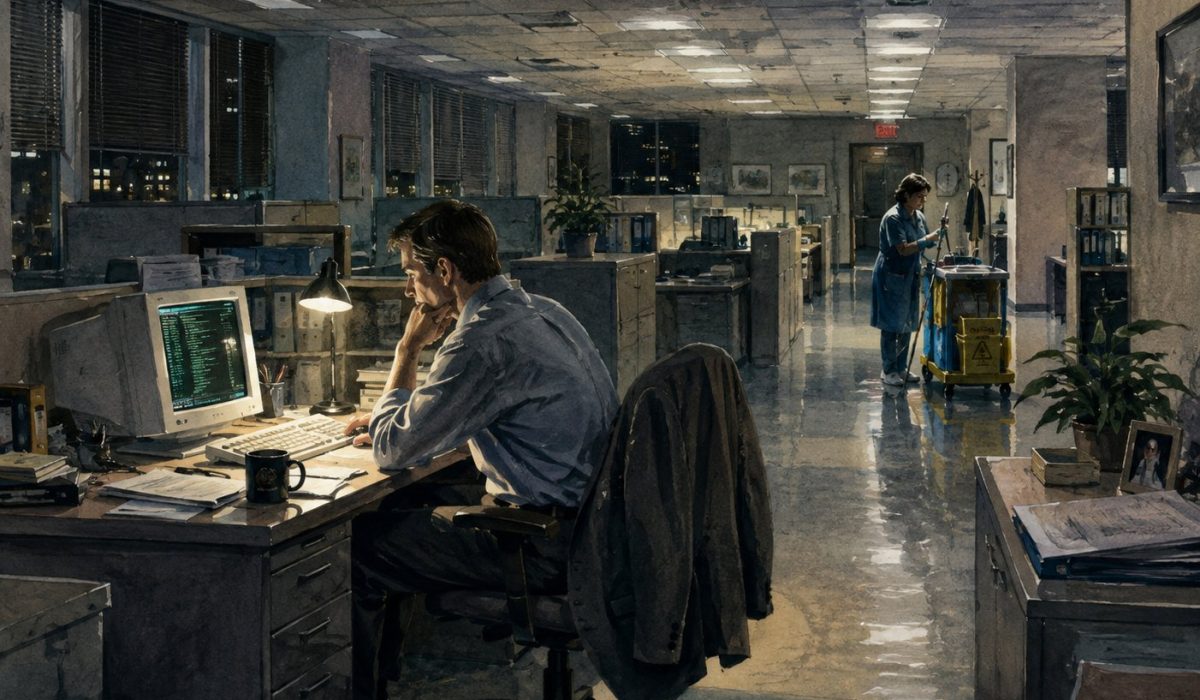
The building was almost empty by the time he realized he was enjoying himself.
That was what he remembered later.
Not the resignation letter or the conversation with his manager. Not even the offer from the small software company that would eventually persuade him to leave. What remained was an evening in an office building after nearly everyone else had gone home, when the fluorescent lights seemed unnecessarily bright and the silence of the corridors made the place feel larger than it did during the day.
He had stayed late to finish something.
That wasn't unusual. He had been with the corporation long enough that late evenings no longer seemed exceptional, particularly when a project approached a deadline. What was unusual was that for the first time all day, nobody needed him.
His calendar had been full since eight that morning. A project review had run long. Then came a budget meeting, followed by lunch at his desk, another meeting about staffing, and an afternoon spent resolving a disagreement between two groups whose responsibilities overlapped just enough that neither could proceed without the other.
He had been useful.
Very useful, in fact.
That was part of the problem.
He had become good at the corporation.
He understood how decisions were made and, equally important, how they were delayed. He knew which managers wanted the details and which wanted only the conclusion. He knew when to push and when to wait. People trusted his judgment. Younger employees came to him with problems, and increasingly managers did too.
There had been another promotion recently, accompanied by a salary increase large enough that his younger self would have considered the matter settled.
This was success.
He knew that.
He was grateful for it.
And yet that evening, after everyone had left, he sat down at his terminal to investigate a software problem someone else would probably have handled the next morning.
He told himself he would spend twenty minutes on it.
The problem was small but interesting. A process that should have completed normally was failing only under a particular combination of conditions. Nothing obvious explained it. He traced one possibility, discarded it, went backward, tried another. Soon he had sheets of printer paper beside him covered with notes and arrows.
The building disappeared.
So did the meetings, the budget, the organizational questions, and the promotion.
There was only the problem.
He followed it deeper.
At some point the cleaning crew came through. A woman pushed a cart past his doorway, disappeared, then returned twenty minutes later and seemed surprised to find him still there.
"You're going to make me come back for you," she said.
He looked at his watch.
Nearly two hours had passed.
"Sorry."
"I'm not. You're the one still at work."
She smiled and continued down the hall.
He leaned back in his chair.
The problem was nearly solved. He could feel it. One assumption had been wrong from the beginning, and now that he had found it the rest was beginning to fall into place.
He should have felt tired.
Instead, he felt better than he had all day.
That realization bothered him.
He turned away from the screen and looked through the darkened office. Empty desks stretched beyond his doorway. A few computer terminals had been left on, their screens casting small rectangles of greenish light into otherwise vacant workspaces. Somewhere farther down the hall, a vacuum cleaner started.
He thought back over the day.
Ten hours at work.
And these last two had been the ones he wanted.
For several months a former colleague named Peter had been talking to him about a small software company. Talking was perhaps too strong a word. Peter occasionally mentioned it over lunch, usually when describing some new problem the company had created for itself.
There were twelve people.
Maybe thirteen now.
Focus Man could never remember.
They built software for businesses too small to have large technical staffs of their own. The projects changed constantly. So apparently did everyone's responsibilities.
Peter made the place sound simultaneously interesting and badly organized.
"They need someone like you," he had said.
Focus Man had laughed.
"What does that mean?"
"Someone who can figure out what we're doing."
"I thought you knew what you were doing."
"We know what we're doing today."
"And tomorrow?"
"That's where you come in."
Focus Man had dismissed the conversation as interesting but impractical.
The corporation offered security. His health insurance was good. Retirement contributions accumulated quietly without requiring much thought. There were paid vacations and predictable raises and an increasingly visible path upward.
The software company offered considerably fewer assurances.
He shut down his terminal and went home.
But the thought followed him.
A week later he met Peter for lunch.
They chose a small restaurant halfway between their offices. Peter arrived late, apologized without much conviction, and spent several minutes complaining about a customer who had changed the specifications on a project for the third time.
"You make this company sound irresistible," Focus Man said.
Peter laughed. "I'm trying not to oversell it."
"You're succeeding."
The waitress brought coffee. Peter added cream to his and stirred it.
"You asked me to tell you what it's really like."
"I did."
"So I'm telling you. We don't have enough people. Half the time we don't know what the next six months look like. Last week the printer quit and three software developers spent forty-five minutes trying to fix it because nobody wanted to pay for a service call."
"Did you fix it?"
"No."
"That's reassuring."
"We bought another printer."
Focus Man smiled.
Peter grew more serious.
"Look, I'm not going to tell you it's safer than where you are. It isn't. I'm not going to tell you you'll make more money, because you probably won't, at least not at first. And if somebody tells you we're going to be the next great technology company, don't believe him. We may not even know what kind of company we're going to be two years from now."
"You're remarkably bad at recruiting."
"I know."
"Why are you there?"
Peter stopped stirring his coffee.
That was the first question that changed the conversation.
He thought for a moment before answering.
"Because when something needs doing, we do it."
Focus Man waited.
Peter continued.
"There isn't a committee to decide which department owns the problem. There usually isn't another department. If a customer needs something and we can figure out how to build it, we build it. Sometimes we get it wrong. Then we fix it."
He took a drink of coffee.
"It's exhausting. Some weeks I think I'm an idiot for staying."
"And the other weeks?"
Peter smiled.
"I think I'm an idiot for having spent as many years as I did someplace else."
Focus Man looked toward the window.
People passed on the sidewalk outside, most of them carrying briefcases or bags from nearby restaurants. The conversation had moved closer to something he had been trying not to name.
Peter watched him.
"You're actually thinking about this."
"I've been thinking."
"That's dangerous."
"I've heard."
Peter waited.
Focus Man said, "I'm doing well where I am."
"I know."
"I just got promoted."
"I know that too."
"My manager has been good to me."
"Then don't make him into the bad guy so you can justify leaving."
Focus Man looked at him.
Peter shrugged.
"People do that. They decide they want something different, then spend six months convincing themselves everything they already have is terrible. Makes the decision easier."
That stayed with him.
Because nothing was terrible.
There was no villain in the story.
No abusive boss. No humiliating failure. No company collapsing around him. Nobody had denied him an opportunity or treated him unfairly.
He had a good job.
That was precisely what made leaving difficult.
Peter asked, "What do you miss?"
Focus Man didn't immediately understand the question.
"About what?"
"Work."
"I'm still working."
"You know what I mean."
He did.
For a while they ate without talking. Peter seemed willing to let the question sit there.
Finally Focus Man said, "Making things."
Peter nodded but didn't rescue him from the thought.
"I spend most of my time now helping other people do the work I used to do. Meetings. Budgets. Schedules. Problems between groups. I'm good at it."
"I know."
"That's not the same as liking it."
"No."
Focus Man looked down at his plate.
"I stayed late last week working on a software problem. Nothing important. I could have handed it to somebody else."
"But you didn't."
"No."
"Why?"
"I wanted to see if I could figure it out."
"And?"
"I did."
Peter smiled. "Was it fun?"
Focus Man disliked the simplicity of the question.
"Yes."
"There's your problem."
They talked about other things after that.
No decision was made over lunch. Peter didn't hand him an offer across the table, and Focus Man didn't return to the corporation prepared to resign. The process was slower and less certain than that.
There were more conversations.
He asked practical questions.
Salary.
Benefits.
Clients.
Cash flow.
What happened if they lost their largest account.
Some of Peter's answers reassured him.
Others did not.
At home, Focus Man made lists. Reasons to stay occupied one side of a yellow legal pad; reasons to leave filled the other. The stay column contained most of the things responsible adults were supposed to value.
Security.
Salary.
Benefits.
Advancement.
Reputation.
The other column was shorter.
Interesting work.
Small team.
Build things again.
He stared at those three lines for a long time.
They seemed inadequate against everything on the other side.
Yet they carried more weight than they should have.
He talked with people he trusted. Most advised caution. One colleague listened quietly and then told him he was crazy.
They were walking toward the parking lot after work when Focus Man mentioned that he was seriously considering the offer.
His colleague stopped.
"You're leaving here for twelve people in an office over a hardware store?"
"Print shop."
"What?"
"The office is over a print shop."
"That's much better."
"There's a hardware store next door."
"Well, then. That changes everything."
Focus Man laughed.
His colleague didn't.
"I'm serious. You know what you've got here."
"Yes."
"Do you?"
They resumed walking.
"You've got people who trust you. You're moving up. You've got benefits those guys probably haven't even thought about yet. Five years from now you could be running this whole operation."
"That's possible."
"And you're thinking about walking away from it."
"Yes."
"Why?"
Focus Man had answered that question several ways over the previous weeks. He had talked about opportunity, flexibility, smaller organizations, technical challenges. All of those answers sounded reasonable.
None seemed quite true enough.
They reached his car.
His colleague leaned against the roof and waited.
Focus Man finally said, "I think I want to find out whether I'm still good at making things."
The other man looked at him for several seconds.
Then he nodded.
"That's the first thing you've said about this that makes any sense."
It wasn't approval.
Focus Man appreciated it anyway.
The resignation letter took less than ten minutes to write and nearly a week to deliver.
It sat inside a folder on his desk while he waited for the right moment. There was always a reason to postpone it. His manager was busy. A project needed attention. Friday seemed unkind. Monday seemed abrupt.
By Wednesday he recognized what he was doing.
He had spent much of his career solving complicated problems by identifying the decision that actually had to be made.
This decision had already been made.
He was merely avoiding the consequence.
Late that afternoon he printed the letter.
One page.
He signed it, folded it once, and carried it down the hallway.
His manager was alone.
Focus Man knocked lightly on the open door.
"Got a minute?"
His manager looked up from a report.
"Sure. Come in."
Focus Man sat across from him.
For a moment he held the folded paper in both hands.
He felt no exhilaration.
No sense of liberation.
Mostly he felt disloyal.
That surprised him.
His manager had invested time in him. The company had given him opportunities. People had trusted him with increasingly important work. Walking away from those things felt less like escaping than disappointing people who had done nothing to deserve it.
He placed the letter on the desk.
"I've decided to leave."
His manager didn't reach for it immediately.
Instead he looked at Focus Man.
"Where are you going?"
He told him.
The manager knew the company vaguely.
"That's a pretty small outfit."
"It is."
"More money?"
"No."
That produced the first hint of a smile.
"Better title?"
"I don't think they know what my title is going to be."
The manager leaned back.
"So let me understand this. You're leaving a larger company, taking more risk, probably working longer hours, and you're not getting more money or a better title."
"That's about right."
"You've thought this through?"
"Probably too much."
His manager looked at the folded letter.
Then he surprised Focus Man by laughing softly.
"Good."
Focus Man wasn't sure what he meant.
The older man reached for the resignation.
"I'd worry about you if you hadn't."
They talked for nearly half an hour.
There was no anger. His manager asked whether anything could persuade him to stay, and Focus Man said he didn't think so. They discussed timing, projects that needed to be handed over, and people who should be told personally rather than through an announcement.
Near the end, his manager said, "You know you can change your mind."
Focus Man nodded.
"I know."
He walked back to his office.
Nothing looked different.
His desk was still covered with the same work. The telephone message beside his keyboard still needed an answer. Tomorrow's meetings remained on his calendar. People passed his doorway without knowing that anything had changed.
For the first time since he had begun considering the decision, he understood that leaving would not feel like a leap.
There was no dramatic moment when the old life fell away and the new one began.
There was simply a sheet of paper on another man's desk.
Then the work of finishing what he had promised to finish.
Weeks later, he would carry a box of personal things out of the building and drive away for the last time. Even then he would not know whether the decision had been brave or foolish.
He certainly could not have known what waited downstream.
He didn't know about the aging brick building or the late-night pizzas and the small group of people who would become friends. He didn't know about the gathering he would almost decline.
And he could not possibly have known about Claire.
Those meanings belonged to the older man looking backward.
The younger man knew only that he had been given a good life and had chosen to leave part of it behind because something in him wanted to build again.
For the moment, that had to be enough.
Posted in focus-man by Geoff Stevens