
The River-Chapter 21
The Recital
By the spring of her junior year, music had stopped being a question.
For a long time Laura had treated it as though it demanded an answer. Either music would become the center of her life or she would eventually have to admit that it wouldn't. There had seemed to be something almost dishonest about loving the piano as much as she did while preparing herself for another kind of career.
College had gradually relieved her of that argument.
She still practiced, although not with the relentless purpose of students preparing for conservatories or graduate programs in performance. Some weeks she played nearly every day. Other weeks an exam or paper intervened and the piano had to wait. She no longer felt guilty about that. The piano was still there when she returned, apparently less concerned about the interruption than she was.
That spring one of her music instructors asked whether she would participate in a student recital.
It wasn't an important concert. There would be no orchestra, no competition, no visiting critics. Students from several studios would perform in one of the smaller recital halls, mostly for families, friends, professors, and other music students who understood the obligation to attend one another's performances.
Laura almost said no.
She wasn't afraid of performing. She had done that often enough. What surprised her was how quickly she began calculating everything the recital would require: additional practice, rehearsals, an evening taken away from studying at precisely the time professors seemed to have agreed among themselves that every paper should be due.
“I'll think about it,” she told her instructor.
Her instructor smiled. “You always think about things.”
“Is that a criticism?”
“An observation.”
Laura thought about that too.
Then she said yes.
Once she committed, an older discipline returned almost without being summoned. She chose a piece she knew well enough to understand its difficulties and liked well enough to endure them. At first she practiced between classes when a room was available, fitting music into the openings of her day. As the recital approached, the sessions became longer.
There were passages her hands remembered better than her mind did. Others seemed determined to account for every hour she had failed to practice during the previous year. She might play four measures correctly, miss the fifth, stop, and begin again. Occasionally the same mistake survived enough repetitions that she became angry with herself.
Then, increasingly, she laughed.
There had been a time when a wrong note seemed to carry evidence about who she was and what she might become. Now it was usually just a wrong note. She corrected it and went on.
Her friends learned about the recital almost accidentally. Several of them were sitting together after class when someone asked what everyone was doing Friday night. Laura mentioned the recital with no more ceremony than she might have mentioned a paper due Monday.
The table became unexpectedly quiet.
“You play piano?” one of the men asked.
Laura looked at him. “Yes.”
“I mean really play?”
“No. Mostly I sit in front of one.”
That got the laugh it deserved, but the questions continued. Laura discovered that several people she had known for more than a year had never heard her play and had only the vaguest idea that music occupied a significant part of her life. They knew she ran. They knew which professors she liked and which classes she complained about. They knew what she usually ordered when they went out and that she could be persuaded to remain at a party considerably later than she intended if the company was good. They knew enough about the men she had dated to hold opinions she had never requested.
But they did not know this.
When one of the women asked whether they were allowed to attend, Laura assured her that they were.
“What do we wear?”
“It's a student recital, not Carnegie Hall.”
“That doesn't answer the question.”
“Clothes would be good.”
By Friday Laura regretted telling them.
Her parents were coming too, and that mattered differently.
They had heard her play for years. They remembered lessons, competitions, recitals, and the long period when music had seemed capable of becoming the organizing principle of Laura's life. They had lived through the years when practicing was sometimes an argument and the later years when nobody needed to remind her. They knew what it had taken for her to become the pianist she was.
Her college friends knew almost none of that history.
Laura wasn't particularly nervous about performing for either group. What unsettled her was the thought of the groups sitting together.
Her parents arrived early, which was predictable enough that Laura had planned for it. She found them in the lobby before she went backstage. Her mother hugged her carefully, mindful of the dress, and told her she looked beautiful. Her father looked toward the doors of the recital hall and asked how many people were expected.
“Dad, it's not a ticketed event.”
“I was just asking.”
“They don't know.”
The uncertainty appeared to trouble him slightly. Her father had spent most of his adult life in a profession where quantities were generally expected to be known.
Laura kissed his cheek. “You'll survive.”
“I wasn't worried.”
“I know.”
Her friends arrived with considerably less efficiency. Laura heard them before she saw them. Someone had parked in the wrong place, someone else had brought another person Laura barely knew, and a disagreement about which entrance to use had apparently been resolved only after trying several of them.
Their voices dropped noticeably when they entered the lobby and discovered that people attending piano recitals behaved differently from people arriving at Friday-night parties.
Laura introduced them to her parents.
For several minutes she stood among people who belonged to different parts of her life. Her mother asked one of her friends about school. Her father began talking to another about something Laura couldn't hear. The sight of them together was strange enough that she wanted to remain and watch.
Then someone backstage called her name.
Laura left them to one another.
The recital began while she waited behind the curtain with the other performers. She listened to the first student play and discovered that her hands were cold.
That annoyed her.
She rubbed them together and flexed her fingers. There was no reason to be nervous. This was not an audition. Nobody was going to decide whether she deserved a scholarship or should continue studying music. Nothing about her future depended on what happened during the next several minutes.
Her hands remained cold anyway.
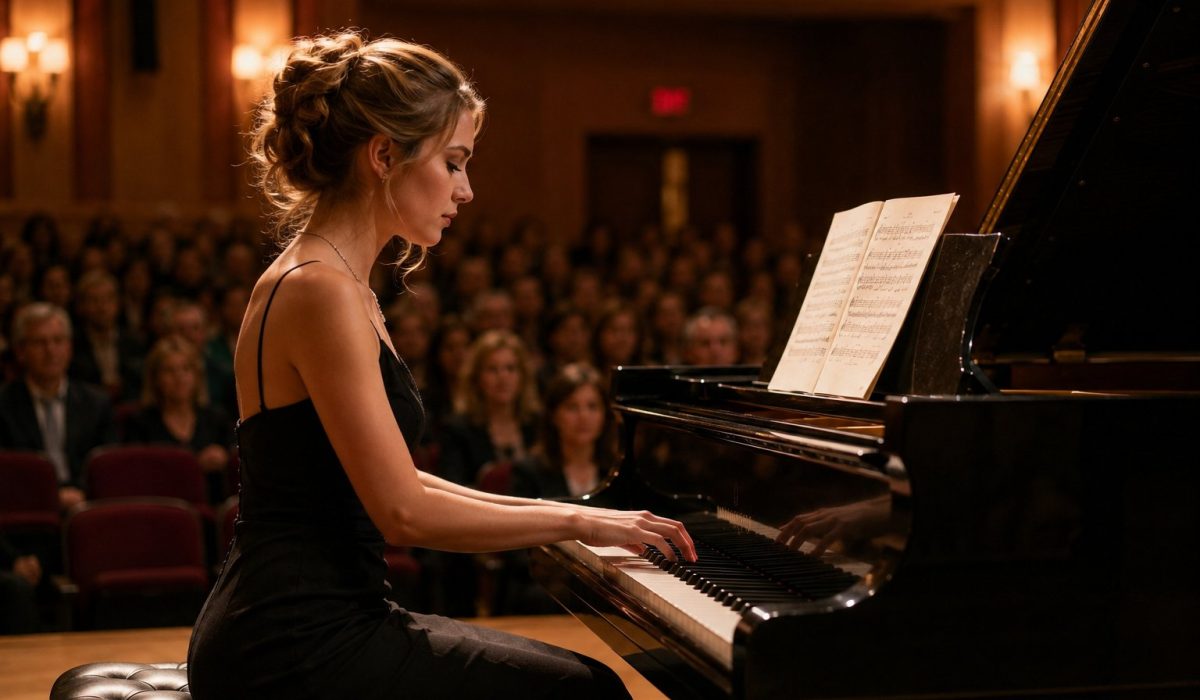
When her turn came, Laura walked onto the stage.
The lights made the audience difficult to see, and she was grateful for that. She could make out shapes in the first few rows but not faces. She acknowledged the applause, crossed to the piano, adjusted the bench, and sat down.
For several seconds she did nothing.
She had always liked that moment before the first note. The room became still because everyone was waiting for her, yet she was under no obligation to begin until she was ready.
Laura placed her hands on the keyboard.
The first notes changed everything.
Her fingers were no longer cold. The audience ceased to matter. Even the recital itself receded. There was only the piece and the physical knowledge of playing it—the opening she had practiced hundreds of times, the movement toward the first difficult passage, the small changes of pressure and timing that she could feel more easily than she could have explained them.
The difficult passage approached.
Laura did not brace for it.
Her hands knew where to go.
She played.
There were imperfections. She knew precisely where they occurred. One note arrived harder than she intended. A phrase she had shaped beautifully in the practice room refused to become quite the same thing onstage.
Once, those small failures would have stayed with her through the rest of the performance. Now they passed almost as soon as they happened. The music was larger than any single note, and Laura continued.
What surprised her was how little she felt she had to prove.
She was not demonstrating that she should have chosen music as a profession. Neither was she proving that she had been right to choose something else. For the minutes she sat at the piano, the distinction had no importance at all.
She was playing because she knew how to play and because she loved doing it.
When she reached the end, Laura held the final sound for as long as the piece required and then lifted her hands.
The note faded into the room.
Applause followed.
She stood, and with the lights no longer quite so disorienting she found her parents. Her mother was smiling. Her father applauded with the serious concentration he brought to things that mattered to him. A few seats away her friends were applauding too, and one of them gave her a look of exaggerated accusation.
Laura understood it immediately.
You neglected to mention this.
She nearly laughed before leaving the stage.
Backstage she listened to the remaining performers with an ease she hadn't expected. The difficult part was over, but that wasn't quite the source of the feeling. She had spent several years trying to determine what music was supposed to mean in her life. For one evening she had stopped asking.
After the recital everyone gathered in the lobby.
Her mother hugged her again and told her she had played beautifully. Her father announced that he had particularly liked the middle section.
Laura looked at him. “The middle section?”
“Yes.”
“Which part?”
“The part in the middle.”
She laughed and kissed him.
Her friends were less restrained. They accused her of hiding a considerable talent from them. Laura protested that she had told them she played piano, which they dismissed on the grounds that lots of people claimed to play piano when what they meant was that they could get through “Heart and Soul” at a party.
The argument might have continued if one of the women hadn't announced that they were going out.
Laura looked toward her parents.
Her mother understood before Laura asked. “Go.”
“Are you sure?”
“We didn't drive all this way to make you spend Friday night with your parents.”
Her father looked as though he might object to the way this characterized their visit, but her mother gave him little opportunity.
They said goodbye outside the recital hall. Laura watched her parents walk toward their car, her father carrying the program he would almost certainly take home with him. Then she turned and found her friends waiting.
The evening immediately became less organized.
There was a discussion about where to eat, another about whether Laura needed to change, and a third about which cars should go where. Laura insisted she was not spending the rest of the night in her recital dress. Her friends insisted she looked fine. Somehow the dispute ended with everyone driving to Laura's apartment before going to a restaurant that might still be serving food and then, perhaps, to a party someone had heard about.
No one appeared to know exactly whose party it was.
An hour later Laura sat with six friends around a table intended for four, wearing jeans and a sweater and eating pizza. One of the men attempted to reproduce what he claimed was the solemn bow she had made after performing.
“I did not do that.”
“You absolutely did.”
“I nodded.”
He repeated the gesture, this time with even greater ceremony.
“You communed with the audience.”
Laura shook her head. “I hate all of you.”
The woman beside her took another piece of pizza. “No, you don't.”
Laura didn't.
They reached the party later than planned, which meant they arrived at roughly the time most other people had intended. The house was crowded and overheated. Music was loud enough to discourage any conversation requiring thought, and people moved continuously between the living room and kitchen carrying drinks.
Laura knew perhaps half the people there and was introduced to several more whose names she forgot almost immediately.
At some point she found herself talking with a man she had met once before.
She remembered him partly because she had thought him attractive the first time and was pleased to discover that the judgment survived a second meeting. He was easy to talk to and funny without seeming to perform for her. More importantly, he appeared interested in what she said. Their first conversation ended when friends pulled them in different directions, but later they found each other again.
Laura noticed that.
She also noticed that she was glad.
They talked for a while near the kitchen and eventually joined a group attempting to dance in a living room that had never been designed for the purpose. Neither of them danced particularly well, which made it easier. Laura laughed more than she danced and stayed at the party considerably later than she had planned.
Sometime after midnight the heat of the house became too much. She slipped through the front door and stood on the porch.
The cool air felt good against her face. Music still came through the walls, softened now by the house itself. Cars filled both sides of the street, and somewhere nearby a group of people laughed as they walked toward another party.
Laura rested her hands on the porch railing.
It had been a long day. That morning she had gone to class. That afternoon she had practiced. That evening she had sat alone under stage lights while her parents and friends listened to her play. Now she was standing outside a college party after midnight, still carrying the faint excitement of the performance and wondering whether the man inside had noticed she was gone.
She didn't have to wonder long.
The door opened behind her.
“There you are,” he said.
Laura turned.
He had apparently been looking for her, and she felt an uncomplicated pleasure in knowing it.
“Here I am.”
“I thought you might have left.”
“Not yet.”
He stood beside her for a moment rather than immediately suggesting they return inside. Laura liked that too. They talked briefly, though afterward she couldn't have said about what. The important part was the ease of standing there together and the awareness, still new enough to be interesting, that neither of them seemed ready for the evening to end.
Eventually he opened the door.
Laura followed him back into the noise and warmth of the house.
She woke late the next morning.
For a few seconds she wasn't sure what had awakened her, and then sunlight coming through the blinds persuaded her that morning had been underway for some time. She got up, made coffee, and carried the cup back into her room.
Her concert dress was still hanging where she had left it. The music from the recital lay on the desk, no longer important enough to be put carefully away. Textbooks were stacked beside it, and her running shoes had been kicked beneath the edge of the bed.
Laura stood there drinking her coffee.
The room contained no particular order. Music beside schoolbooks. Running shoes on the floor. The dress from the night before. Somewhere among the ordinary clutter were the clothes she had worn to the party.
She thought briefly about the recital and her father's mysterious appreciation of its middle section. She remembered her friends' surprise when they heard her play. She remembered the cool porch after midnight and the door opening behind her.
Then she noticed the time.
She had things she needed to do.
Laura set down her coffee, picked up the music, and put it away.
Posted in the-river by Geoff Stevens