
The River-Chapter24
The Application
For several weeks after Laura first said the words aloud, law school remained pleasantly theoretical.
She could talk about it with her professor, mention it to friends, even tell her parents that she was considering it, and none of those things required her to become the person who actually went. Maybe had room in it. It allowed her to imagine one future without surrendering all the others, and Laura had become increasingly comfortable with possibilities that did not immediately demand decisions.
Applying was different.
She discovered that one afternoon in the university advising office, where a woman reached into a file cabinet and handed her a collection of forms and booklets that gave physical substance to what until then had been mostly an idea. There were instructions for registering for the LSAT, information about transcripts and recommendations, application deadlines, lists of schools, and enough fine print to suggest that the legal profession had already begun testing her willingness to read things nobody else wanted to read.
Laura carried everything home and spread it across the table.
The LSAT booklet was particularly uninviting. She worked through several sample questions, some of which she found genuinely interesting and others that seemed deliberately designed to make ordinary language more difficult than necessary. One required her to determine which conclusion necessarily followed from a collection of conditions she had already read three times.
“Nobody talks like this,” she said.
There was no one in the apartment to defend the examination.
She worked through it anyway.
That first evening told her most of what she needed to know. The test wasn't beyond her, but neither was it something she could walk into on a Saturday morning and expect intelligence alone to carry her through. There were patterns to learn and kinds of reasoning she could improve with practice. Laura understood that sort of work. Years at a piano had taught her not to be offended by the need for repetition.
So she registered.
The act itself was almost disappointingly ordinary. She filled out a form, wrote a check, put both into an envelope, and mailed them. Nothing about the process made her feel more like a future lawyer. She had simply agreed to spend a Saturday taking an examination.
Still, it was the first thing she had actually done about law school.
Preparation settled into the life she already had. By senior year Laura was accustomed to competing demands. Classes occupied one part of the day, friends another. She ran when she could and continued playing the piano without the old anxiety about whether she was devoting enough time to it. Now LSAT questions appeared among everything else. She carried them to the library and worked on them between classes, sometimes enjoying the logic and sometimes becoming irritated enough with an answer to spend considerably more time proving why the test makers were wrong than it would have taken to accept their explanation and move on.
One evening a friend found her doing exactly that.
“So this is real now,” she said, looking at the LSAT book.
Laura glanced at the pages covering the table. “I suppose.”
“I thought you were still deciding.”
“I am.”
Her friend pointed toward the book. “You have a strange way of being undecided.”
Laura laughed, and they moved on to other things. Afterward, though, she found herself thinking about the comment.
There was some truth in it. The process had begun acquiring momentum. Register for the test, prepare for it, take it. If the score was good enough, investigate schools. Request transcripts. Ask for recommendations. Complete applications. None of the individual steps constituted a decision about her life, but together they were beginning to take her somewhere.
That was why the LSAT score mattered more than she expected when it arrived several weeks after the examination.
Laura opened the envelope alone at her apartment and read the number twice.
It was good. Not the sort of score that would cause every law school in the country to pursue her, but comfortably good enough to keep the possibility open. There were schools she respected where she could apply with a reasonable expectation of being taken seriously.
She sat at the table with the score in front of her.
She was pleased. She had prepared carefully and done well, and there was satisfaction in that. But underneath the satisfaction was something she hadn't anticipated.
A poor score could have answered the question for her.
Laura might have been disappointed, but she could have told herself that she had investigated law school, made a legitimate attempt, and discovered that another direction made more sense. There would have been a neatness to that outcome.
Instead, she had done well enough that the decision remained hers.
When she called home that evening, her father immediately wanted to know whether the number was good, then how good, and finally what it meant in practical terms. Laura found herself laughing while she explained the scoring system.
Her mother listened to the explanation and then asked what happened next.
“I guess I figure out where to apply.”
“Do you want help?”
Laura paused.
The question mattered because of what her mother had not said. She had not offered to make a list or suggested schools or asked Laura to bring everything home so they could sort through it together. She had simply asked whether Laura wanted help.
There had been a time when Laura would have wanted exactly that. She would have spread the possibilities across the dining-room table and listened while her parents helped determine which ones were sensible.
“Maybe,” she said. “Let me look first.”
Her mother accepted the answer without argument.
Laura was becoming accustomed to that small change in their relationship. Her parents were still there, and she had not stopped valuing what they thought. But increasingly she brought decisions home after she had begun making them rather than going home to discover what the decisions should be.
Choosing schools proved more difficult than taking the test.
The test had right answers. Law schools did not.
Laura approached the problem in the way she approached most problems: she gathered information. She compared tuition, admissions requirements, locations, reputations, and programs whose significance she was not yet entirely qualified to judge. Before long she had created columns and rankings and a numerical system that gave the whole process a reassuring appearance of precision.
A friend looked over the pages one evening and asked why Laura had assigned numbers to locations.
“I'm comparing them.”
“I can see that. How do you give a city a number?”
“I like some places more than others.”
“Very scientific.”
“It's my list.”
Her friend continued studying it, apparently unconvinced by Laura's methodology. Then she asked which school Laura actually wanted to attend.
Laura explained that this was precisely what the lists were intended to determine.
Her friend shook her head. “No. You're figuring out which one wins.”
Laura started to defend herself and then looked again at the columns.
Her friend smiled. “You're welcome.”
After she left, Laura remained at the table.
The numbers weren't useless. Tuition mattered. Admission requirements mattered. Geography mattered considerably. But some schools interested her for reasons she couldn't assign a numerical value, and one in particular was farther from home than she had ever seriously imagined living.
For several minutes she considered eliminating it for that reason alone.
Then she didn't.
The previous summer returned to her in fragments: three women with too much luggage, inexpensive motels, the Pacific appearing and disappearing beside the highway, the dress she hadn't needed, David's address tucked into her suitcase. She remembered returning home and finding the kitchen almost exactly as she had left it.
That trip had been temporary. She had always known she was coming back.
Law school somewhere else would be different. Laura would have to find a place to live and learn another city. She would need new friends, a grocery store, somewhere to run and perhaps somewhere to play piano. There was a time when that list would have sounded mostly like things she was giving up. Now she found herself wondering what it would be like to build another life somewhere unfamiliar.
She left the school on the list.
The professor who had first asked whether she had considered law school agreed to write a recommendation. When Laura approached him, he seemed pleased but not particularly surprised.
“So you considered it,” he said.
“I did.”
“And?”
“I'm applying.”
The professor smiled. “That's not what I asked.”
Laura knew what he meant. She admitted that she still wasn't certain she wanted to go.
He seemed entirely comfortable with that. When she named the schools she was considering, he listened and then asked which one she wanted.
“I don't know yet.”
“Then apply to all of them.”
Laura looked at him. “That's your advice?”
“Give yourself something to choose from.”
The answer seemed suspiciously simple. Laura spent several days trying to improve upon it before concluding that he was probably right.
The applications themselves required less soul-searching than she had expected until she reached the portions that were supposedly about her.
Names, addresses, dates, schools attended—those were facts, and Laura was good at facts. Then she encountered the question she had known would eventually appear.
Why did she want to study law?
Laura stared at the page.
She still wasn't entirely certain that she did.
The obvious answers sounded false as soon as she wrote them. She had no childhood memory of announcing that she wanted to become a lawyer. No courtroom experience had awakened a calling. She could not truthfully claim that every choice in her education had been preparing her for this moment. Her path had been considerably less orderly than the application seemed to prefer.
There had been music. There was business. There had been the professor's unexpected question.
More recently there had been her growing interest in organizations not simply as systems but as collections of people making decisions whose consequences extended beyond themselves. She was interested in responsibility and competing interests, in what happened when reasonable people disagreed and there was no answer everyone could simply accept. She liked understanding how rules worked, but she was becoming even more interested in what happened when the rules met actual people.
She wrote about that.
The first version sounded impressive.
It also sounded like someone else.
Laura read it the following morning and wondered who the earnest young woman on the page was and whether a law school might prefer admitting her instead.
She put the essay away.
When she returned to it the next evening, she stopped trying to sound like a future lawyer and wrote about what she actually wanted to understand. The result was shorter and less ambitious. It made fewer claims about the person she would someday become.
It sounded like Laura.
By the time she completed the applications, the process that had once seemed overwhelming had become a stack of large envelopes on her desk. She checked each one repeatedly, despite knowing that a fourth inspection was unlikely to reveal something the first three had missed.
Then she began mailing them.
One envelope at a time, the possibilities left her desk.
All except the last.
There was nothing obviously different about that application. The forms were complete. Her transcript had been requested. The recommendations were arranged, the essay finished, and the check enclosed. Yet the envelope remained in her apartment for two days after the others were gone.
On the third morning Laura put it in her bag and carried it to campus.
She intended to mail it between classes.
She didn't.
At lunch she passed a mailbox and continued walking. Laura noticed what she had done but didn't turn around. She told herself she would mail it later.
That afternoon the application went with her to the music building.
Laura took it from her bag while looking for her music, saw the law school's address, and put it back. Then she sat at the piano and practiced for nearly an hour.
For most of that hour she forgot the envelope was there.
She worked through a passage that had been bothering her, slowed it down, repeated it, and eventually reached the point where her hands stopped fighting it. She played something else simply because she liked it. The familiar concentration took over, and law school disappeared along with everything else outside the room.
When she finished, the application was still in her bag beside the piano bench.
Laura looked at it for a while before putting on her coat.
Only then did she begin to understand why this particular envelope had become difficult.
For months she had been protected by maybe.
Maybe law school. Maybe another city. Maybe a profession she still knew more about from conversations and reading than from experience. There was safety in investigating a possibility because investigation could always end with a decision not to continue.
An application was different.
A law school could reject her, of course. But it could also say yes.
Then the decision would return to Laura.
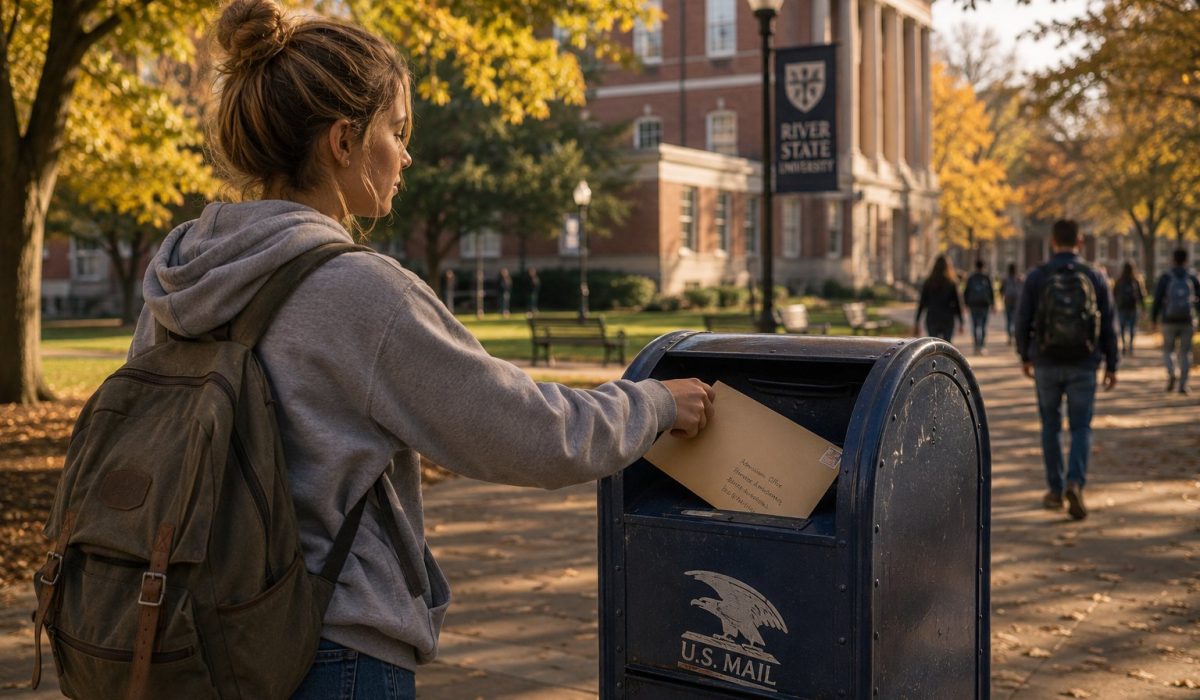
She left the music building and walked across campus with the envelope under her arm. Students passed in both directions, carrying books and talking about things that had nothing to do with her future. A bicycle went by. Somewhere behind her a bell marked the hour.
When she reached the mailbox, Laura stopped.
Her return address was written neatly in the corner of the envelope: her name, her apartment, the small coordinates of the life she had built during these college years.
She thought of her room, her friends, the business building and the practice rooms. She thought of running before class and of driving home on roads she now knew well enough to travel almost without noticing. None of those things had been part of a plan when her parents first left her at the dormitory.
They had simply become her life because she had stayed long enough to make one.
Laura opened the mailbox.
For another moment she held the envelope.
Then she let it fall inside.
She heard it land.
The sound was considerably less impressive than the months of thought that had preceded it.
Laura smiled.
She had a class the next morning and reading to finish before then. There was music she wanted to practice again later in the week. One of her friends had mentioned a party Friday night, although nobody seemed to know yet where it was. Her mother would probably call over the weekend, and if Laura told her the last application had finally been mailed, her father would almost certainly ask when she expected an answer.
All of that remained exactly where she had left it.
She turned away from the mailbox and started across campus.
The application had gone somewhere she could no longer retrieve it.
For now, that was enough.
Posted in the-river by Geoff Stevens