
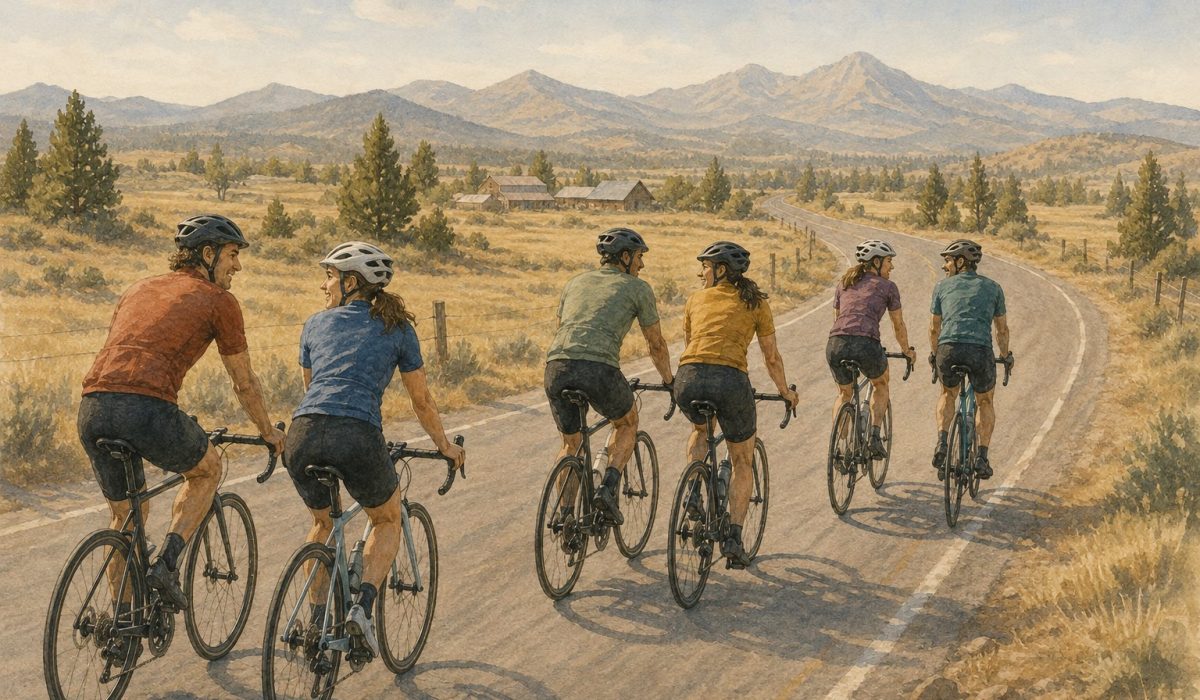
Friends Who Share Part of the Road
Some friendships begin with an introduction. Others begin because two people happen to be traveling in the same direction.
On a bicycle ride, there is often a period before anyone knows what kind of day it will become. Riders arrive one at a time. They unload bicycles, check tires, adjust clothing, and talk about the weather. Some already know one another. Others stand near the edge of the group, listening for a name they recognize or waiting for someone to make room in the conversation.
Then the ride begins.
The group stretches out along the road. The strongest riders move toward the front. Others settle into a pace that feels sustainable. Before long, people who may have exchanged only a few words in the parking lot find themselves riding side by side.
The conversation usually begins with the road ahead. Someone asks how far we are going, whether the climb is difficult, or where the next turn will be. From there, the subjects widen. We talk about bicycles, work, families, health, travel, retirement, and the small frustrations of daily life.
No one formally announces that a friendship has begun. There is only another ride, another conversation, and the growing familiarity of seeing the same person waiting at the start.
Many friendships develop this way. They begin not with a decision to become close, but with something two people enjoy doing together.
Friendship in Motion
Conversation changes when people are moving.
On a bicycle, we usually ride beside each other rather than sit face to face. There is no expectation of constant eye contact. The road supplies interruptions: a passing car, a hill, a turn, or the need to fall into single file. A serious conversation may pause for several miles and then resume as though nothing has happened.
This can make honesty easier.
A person may say something while looking toward the road that would feel too exposed across a table. The words are carried forward by the motion of the ride. Silence does not necessarily mean discomfort. Sometimes it means the hill is steep. Sometimes both riders are thinking. Sometimes the scenery deserves their attention.
Other activities create their own forms of companionship. People talk while walking, gardening, preparing food, delivering meals, repairing something, or setting up chairs before a meeting. Chess players may reveal themselves in the choices they make across the board long before they discuss their lives away from it.
The activity gives the relationship somewhere to begin. It removes the pressure of sitting down for the explicit purpose of becoming friends.
At first, the connection may belong almost entirely to that shared interest. We know where someone likes to ride but not where they grew up. We know how they respond to a difficult chess position but not how they respond to a family crisis. We know they are dependable on Wednesday mornings, even though we have never met the people waiting for them at home.
This does not make the friendship superficial.
It simply means that we share one part of the road.
The Value of a Partial Friendship
We sometimes judge relationships by how much of our lives they contain.
A close friend is expected to know our history, understand our weaknesses, appear during hardship, and remain present through changing circumstances. These are valuable relationships, and most of us are fortunate if we have even a few.
But not every friendship must become that large.
There are friends with whom we share an activity, a season, a workplace, a neighborhood, or a recurring hour of the week. They may know us well within that part of life and very little outside it.
The friend who rides beside me may understand my determination better than someone who has known me for years. They have seen how I respond when the wind rises, the road steepens, or fatigue begins changing my decisions. They know whether I keep a steady pace, push beyond what is sensible, complain about the climb, or quietly continue.
At the same time, they may know almost nothing about the work waiting on my desk, the worries that kept me awake, or the memories that have shaped me.
Both things can be true. They can know something important about me without knowing everything.
A partial friendship is not an incomplete friendship. It is a relationship with a particular shape.
Problems arise when we mistake that shape for a promise that the relationship will expand. We may assume that because a person enjoys riding, walking, volunteering, or playing chess with us, they will also want to share every other part of life. Sometimes they will. Often they will not.
The friendship has not failed because it remains where it began.
It may already be giving both people exactly what they have chosen to share.
What Repetition Builds
Activity-based friendships often grow through repetition rather than disclosure.
We learn about another person by watching what they do. Do they wait at the top of the hill? Do they notice when someone is missing? Do they keep their commitments? Can they lose a game without becoming unpleasant? Do they make room for the newcomer who is standing alone?
Trust accumulates through these small observations.
A person who arrives when they say they will becomes someone we can depend upon. A rider who stays with us during a mechanical problem becomes more than another name on the group list. A volunteer who quietly completes the unglamorous work earns a different kind of respect than someone who speaks often about being helpful.
Over time, conversation deepens. We remember what the other person told us the week before and ask what happened next. We learn the names of people we have never met. We recognize when a familiar joke is covering a real concern.
The relationship may still remain centered on the activity, but the activity is no longer the only reason it matters.
Repeated contact gives friendship something modern life often denies it: time to develop without being forced.
The Distance Between Meetings
One of the pleasures of these friendships is that they can survive a certain amount of space.
We may see someone only on weekly rides, at monthly meetings, or during a particular season. There may be little communication between those occasions. Yet when the group gathers again, the relationship resumes.
This rhythm can be especially valuable in later life. People carry families, health concerns, travel, volunteer work, and responsibilities that are not always visible to one another. A friendship that does not demand constant attention may be easier to sustain than one measured by the frequency of calls or messages.
But low demand should not be confused with indifference.
A relationship still needs signs of life. We notice when someone has been absent. We ask whether they are all right. We send the route, extend the invitation, or let them know that their presence was missed.
Sometimes one small message keeps a person connected to a community they were beginning to lose.
There is a balance to be found. We can care without monitoring, invite without pressuring, and welcome without requiring an explanation. The goal is not to keep every person continuously close. It is to leave the road open enough that they can return.
When the Pace Is Different
Every shared activity eventually reveals differences.
One cyclist wants to ride faster. Another wants more time to look at the scenery. One chess player studies openings and measures progress; another plays for conversation and enjoyment. One volunteer wants to improve the entire organization, while another is content to complete a familiar task each week.
These differences can strain a friendship if we believe that caring about someone requires wanting the same experience.
On a group ride, the difference becomes physical. One person gradually moves ahead while another falls behind. Sometimes the faster rider waits. Sometimes the group separates and meets later. Neither choice necessarily reflects the value of the friendship. It may simply reflect what each person needs from that day.
Relationships also have pace.
One person may become comfortable quickly, sharing personal stories and extending invitations. Another may require more time. One may want frequent contact; the other may prefer a friendship that lives mainly within the activity they share.
We can interpret this difference as rejection, or we can recognize that people approach closeness at different speeds.
A good companion does not insist that everyone ride at the same pace all the time. They pay attention, communicate, and decide together where it matters to remain close.
The Road Does Not Belong to Us
Friendship becomes more difficult when appreciation turns into possession.
We may become accustomed to riding with a particular person, sitting beside them, or receiving most of their attention. When they develop other friendships or join another group, we feel the arrangement changing.
The feeling may be small enough that we do not name it. We become quieter. We make a joke with an edge to it. We tell ourselves that the other person has changed.
What may really have changed is our sense of ownership.
No friendship gives us exclusive rights to another person’s time. The people we care about are allowed to have relationships that do not include us. They are allowed to pursue interests we do not share, travel roads we cannot follow, and give their attention to people whose company they also enjoy.
This can be difficult to accept, especially when a friendship has become important to us. Yet trying to secure our place through pressure, guilt, or constant attention usually damages the connection we hoped to protect.
Friendship is strongest when both people are free to return to it.
We do not keep a companion by closing the other roads.
The Friends Who Continue Elsewhere
Not every friendship will last.
Someone stops attending the group. A job changes. A person moves away, develops health problems, loses interest, or finds another activity that fits their life better. Sometimes there is no disagreement and no final conversation. Two people simply stop arriving at the same place.
These endings can feel strangely incomplete. Because the friendship was built around an activity, we may believe we do not have the right to grieve it. We were not family. We may never have visited each other’s homes. Perhaps we did not even know how important the companionship had become until it disappeared.
But we feel the absence.
We remember the person when we reach the hill where they always pulled ahead or the intersection where they told the same story more than once. The place they occupied in the group closes gradually, although it is never filled in quite the same way.
Some friendships belong to a particular stretch of life. That does not make them temporary in the sense of being disposable. Their influence continues after the shared activity ends.
A person may have encouraged us when our confidence was low. They may have introduced us to a community, challenged us to become stronger, or made an ordinary weekly routine something we looked forward to.
They traveled far enough beside us to change the journey.
That is worth remembering.
Sharing the Miles We Have
There is a temptation to ask every meaningful relationship where it is going.
Will this person become a close friend? Will the friendship extend beyond the activity that brought us together? Will it last?
These questions are understandable, but they can pull our attention away from the relationship that is already present.
Today there is a road in front of us and someone riding beside us. There is a conversation that would not be happening if both of us had not arrived. There is companionship for this part of the journey.
Perhaps the friendship will deepen. Perhaps it will remain within the few hours we share each week. Perhaps life will eventually lead us in different directions.
We do not need to decide all of that in advance.
We can appreciate the friend who knows only part of our life and allow that part to be enough. We can be interested without intruding, dependable without becoming possessive, and open to greater closeness without requiring it.
We can notice who is beside us and offer them the same freedom we hope to receive: the freedom to set their own pace, choose their own road, and share what they are ready to share.
Some friends will remain with us for most of our lives. Others will join us for only a few miles.
What matters is not that every companion reaches the same destination.
It is that, for a while, neither of us had to travel alone.
Note: To continue: Click 'RELATIONSHIPS' after the words 'POSTED-IN' below.
Posted in relationships by Relationship Editor