
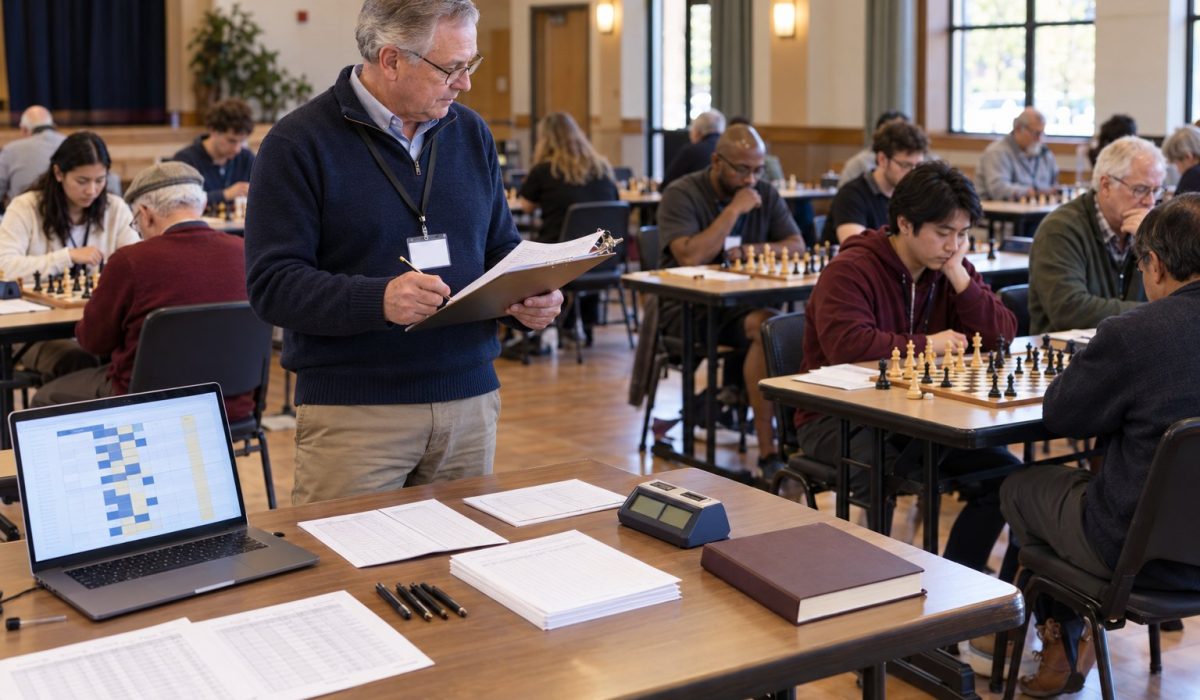
How to Become a US Chess Tournament Director
How to Become a US Chess Tournament Director
A successful chess tournament can look almost effortless from the playing hall. The pairings appear, the clocks start, questions are answered, results are posted, and the next round begins.
Behind that orderly progression is a Tournament Director.
A US Chess-certified Tournament Director—usually called a TD—is the official responsible for conducting a US Chess-rated tournament according to established rules and procedures. The director protects the fairness of the competition, manages the mechanics of the event, resolves problems, and ensures that the results submitted for rating are accurate.
Becoming a certified TD is therefore more than learning how to operate tournament software. It means accepting responsibility for the players, the rules, and the integrity of the event.
What Does a Tournament Director Do?
The Tournament Director’s work begins well before the first move.
Before an event, the director may help determine:
-
The tournament format and number of rounds
-
The time control
-
The rating system that will apply
-
Player sections and eligibility requirements
-
Registration procedures
-
Pairing methods
-
Tie-break procedures
-
Equipment and playing-room requirements
-
Rules concerning byes, withdrawals, electronic devices, and late arrivals
Some of these responsibilities may be shared with a tournament organizer. The organizer usually handles matters such as the venue, publicity, registration fees, prizes, and event promotion. The Tournament Director is primarily responsible for the competitive and regulatory side of the tournament.
One person can perform both roles, especially at a small local event, but the responsibilities are different.
Responsibilities During the Tournament
Once play begins, the TD becomes the principal authority for the tournament.
The director produces or supervises the pairings, announces the conditions of play, starts the rounds, records results, and responds when players have questions or disputes.
Situations requiring a director might include:
-
An illegal move
-
A clock that was set incorrectly
-
A player arriving late
-
A disagreement about whose turn it is
-
A draw claim
-
A question involving touch-move
-
A player receiving outside assistance
-
An electronic device making noise
-
An error in a reported result
-
A pairing or score discrepancy
Many rulings are straightforward. Others require careful attention to the facts, the tournament announcement, and the US Chess rulebook.
A good director remains calm, listens to the players, avoids taking sides, and applies the rules consistently. The goal is not to dominate the event but to create conditions in which the players can concentrate on chess.
Responsibilities After the Tournament
The director’s work does not end with the final handshake.
Results must be reviewed for accuracy and prepared for submission. Player identification numbers, scores, colors, opponents, byes, sections, and other information must be correct before the event is rated.
An error in the tournament report can affect several players’ official records. Careful reporting is therefore an important part of a director’s responsibility.
The event must be submitted through the appropriate US Chess system under an active US Chess affiliate. Certification as a Tournament Director and authorization through an affiliate are related, but they are not the same thing.
Why Is Certification Necessary?
US Chess certifies Tournament Directors to standardize tournament procedures and ensure that rated events are conducted by people with an appropriate level of knowledge and experience.
A rated tournament affects more than the players in the room. Its results become part of the national rating system. Those ratings may later be used to determine tournament sections, pairings, prizes, rankings, qualifications, and titles.
Certification establishes that the director has agreed to follow US Chess rules and administrative requirements. It also creates a progressive system in which directors gain experience before assuming responsibility for larger or more complex events.
Tournament aides can assist with clerical work without being certified. However, responsibilities such as making pairings and enforcing rules belong to certified Tournament Directors.
The Levels of Tournament Director Certification
US Chess provides several levels of TD certification:
-
Club Tournament Director
-
Local Tournament Director
-
Senior Tournament Director
-
Associate National Tournament Director
-
National Tournament Director
The Club TD designation is the normal entry point. It is intended for directors beginning with smaller local tournaments.
Advancement to higher levels requires additional directing experience and greater demonstrated knowledge of tournament rules and procedures. Higher certifications allow a director to take responsibility for larger and more demanding events.
A new director does not need to begin with ambitions of directing a national championship. A small club tournament is an appropriate and valuable place to learn.
Beginning as a Club Tournament Director
US Chess currently requires an applicant for Tournament Director certification to be a US Chess member in good standing. Applicants must also meet current age and Safe Play training requirements and have access to the current edition of the US Chess Official Rules of Chess, including relevant updates.
The entry-level Club TD application includes a statement that the applicant has read, has access to, and agrees to follow the official rules.
Under the current certification rules, no examination is required for a Club TD’s initial three-year term. Testing, documented experience, or other requirements apply when renewing or advancing, according to the current US Chess certification standards.
Because requirements and forms can change, applicants should always use the current Club TD application and instructions available on the official US Chess Tournament Directors page.
Certification Is Only Part of Running a Rated Event
Becoming certified does not automatically create an organization authorized to submit tournaments.
A US Chess-rated event must be associated with an active US Chess affiliate. An affiliate might be an established chess club, school, state chess organization, tournament organization, or another approved group.
A new TD can work with an existing affiliate and experienced director. A club or organization may also apply to become an affiliate if it intends to sponsor rated tournaments.
Working with an established director for the first few events is highly advisable. Tournament software can generate pairings, but it cannot replace a director’s judgment when a rule question or unusual situation arises.
Knowledge Matters More Than the Software
Pairing software is an important tool, particularly for Swiss-system tournaments. It can calculate pairings, track standings, identify some data errors, and prepare rating reports.
The software does not decide whether a player made an illegal move, whether a draw claim is valid, or how to handle an unforeseen disruption. Those decisions remain the responsibility of the Tournament Director.
A capable TD should understand the pairing principles well enough to recognize when something looks wrong. The director should also know how to preserve records and continue the event if a computer, printer, or internet connection fails.
A Practical Path to Certification
Someone interested in becoming a Tournament Director can begin with these steps:
-
Maintain a current US Chess membership.
-
Review the Tournament Directors section of the US Chess website.
-
Obtain access to the current US Chess rulebook and its updates.
-
Complete the required Safe Play training.
-
Submit the current Club TD application.
-
Connect with an active US Chess affiliate.
-
Assist an experienced director at one or more tournaments.
-
Learn the tournament and pairing software used by the affiliate.
-
Begin by directing an appropriately sized local event.
-
Keep records of directing experience for renewal or advancement.
Applicants should allow sufficient processing time before any tournament at which certification will be required.
Serving the Chess Community
A Tournament Director may not play a move, win a prize, or appear in the final standings, but the director makes organized competition possible.
For a community such as Central Oregon, developing local Tournament Directors can lead to more rated events, shorter travel distances for players, and new opportunities for both experienced competitors and people entering their first tournament.
The role requires preparation, patience, accuracy, and sound judgment. For someone who enjoys chess and wants to help build the local chess community, becoming a certified Tournament Director can be a practical and rewarding form of service.
Official US Chess Resources
Tournament Director and Affiliate Frequently Asked Questions
Certification rules, applications, training requirements, forms, and procedures may change. Consult the official US Chess website before applying or organizing a rated event.
Posted in tournament-organization--software by Chess Resources