
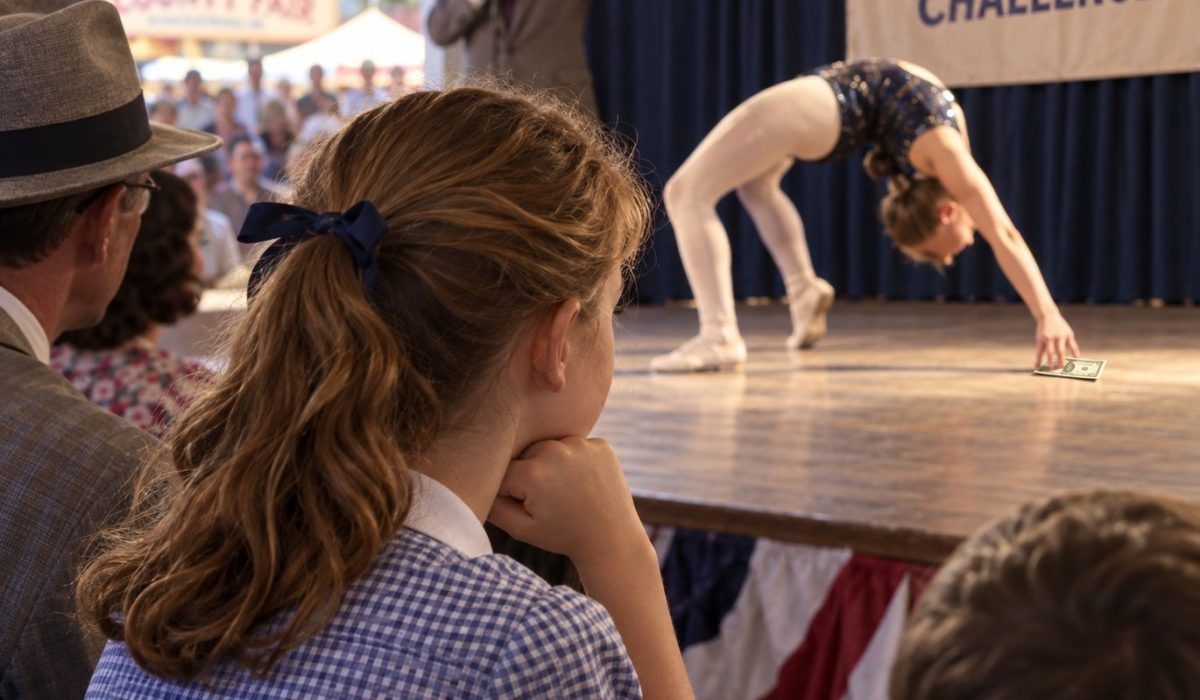
The Dollar On The Floor
Theresa was about ten years old when she learned something about fear.
It happened at some kind of public event she attended with her parents. She no longer remembers exactly what it was—a fair, perhaps, or some other gathering where there was a stage and people watching from an audience.
Someone on the stage issued a challenge.
A dollar was placed on the floor. If anyone in the audience could do a backbend and pick up the dollar, they could have it.
Theresa knew she could do it.
She had taken ballet. She had done tumbling. She was unusually flexible and athletic. Bending backward far enough to pick up a dollar wasn't beyond her ability.
She could have walked onto that stage and done it.
But she didn't.
Someone else did.
And that bothered her.
It wasn't the dollar. It wasn't even that someone else had done something she could do.
Theresa was angry because she knew why she had stayed in her seat.
She had been afraid.
For a ten-year-old girl, walking onto a stage in front of a crowd was different from doing a backbend where nobody was watching. The physical part wasn't the problem. The difficult part was standing up, walking forward, and allowing everyone to look at her while she tried.
She let that stop her.
And afterward, she was furious with herself.
Years later, after a life filled with much larger events, Theresa could still remember that small one. Asked to identify moments that had changed the direction of her life, she had trouble coming up with many.
Her life, she explained, hadn't worked that way.
There had been marriages and deaths, college and careers, motherhood and retirement. There had been moves and journeys to distant parts of the world. But she didn't see her life primarily as a series of dramatic events that forced her onto new roads.
The dollar was different.
Not because of what happened.
Because of what Theresa decided afterward.
She wasn't going to do that again.
That didn't mean she would automatically say yes whenever an opportunity appeared. Theresa wasn't interested in becoming reckless simply to prove that she wasn't afraid.
Instead, she began asking herself a question.
Do I really not want to do this—or am I saying no because I'm afraid?
Those were two very different answers.
If she genuinely didn't want to do something, fine.
But fear wasn't going to be allowed to disguise itself as a decision.
That distinction became part of the way Theresa approached the world.
It was there when a girl from a small Central Oregon town left for college. It was there as she built a career working with young people other people had labeled delinquent. It was there when she moved from working directly with kids to running programs and dealing with administrators, courts and government agencies.
It followed her into relationships and motherhood, retirement and loss.
And it traveled with her.
Decades after the dollar on the floor, Theresa would find herself in places a ten-year-old girl growing up in Redmond could hardly have imagined—China, Ecuador, the Amazon, the Galápagos.
She would encounter plenty of reasons to hesitate.
But hesitation and fear weren't quite the same thing anymore.
Theresa had learned to stop and make the distinction.
She describes herself today as fearless, although that isn't entirely accurate.
She understands risk.
She is practical about her limitations. There are things she won't do simply because she considers them foolish. She isn't going to bungee jump just to demonstrate courage.
What changed that day wasn't her ability to feel fear.
It was the authority she was willing to give fear.
And perhaps that is why this tiny childhood memory survived when so many larger moments became harder to identify as turning points.
Nothing visibly changed that day.
Theresa didn't win the dollar.
Nobody watching knew that anything important had happened.
She simply went home knowing that when the opportunity had come, she had been capable of stepping forward—and hadn't.
She didn't like that feeling.
So the next time life put something in front of her, she intended to make a different kind of decision.
Not:
Am I afraid?
But:
Is this something I really want to do?
If the answer was yes, Theresa would find a way.
She has been doing that ever since.
To continue click on the words "THERESA THORSON" after the words "POSTED-IN"
Posted in theresa-thorson by Stories Worth Saving