
There is Always a Solution
Theresa was somewhere in Beijing when her traveling companion announced that she needed a bathroom.
Not eventually.
Now.
They were riding on a tour bus, heading across the city to an evening event. Theresa remembers it as some kind of karate performance. Beijing was large enough that getting there would take hours, and the bus didn't have a restroom.
Her friend, Bobby, couldn't wait that long.
So Theresa told the driver he needed to stop.
There was an obvious problem with this plan.
They were in Beijing.
They didn't speak Chinese.
They weren't especially sure where they were.
And if they got off the bus, they would miss the evening's scheduled event.
The driver pointed that out.
Theresa wasn't particularly concerned.
Fine, she told him. Just drop us off.
They would figure it out.
Years earlier, when Theresa was about ten, she had sat in an audience while someone offered a dollar to anyone willing to come onto a stage, do a backbend, and pick it up from the floor.
Theresa could do the backbend.
What she couldn't do was make herself walk onto the stage.
Someone else got the dollar.
Theresa went home angry with herself and made a decision that stayed with her: she wasn't going to let fear make choices for her.
That didn't mean charging foolishly into every situation that presented itself.
It meant learning to distinguish between two very different thoughts:
I don't want to do this.
and
I'm afraid to do this.
By the time she found herself getting off a tour bus in Beijing, Theresa had been practicing that distinction for most of her life.
And Bobby needed a bathroom.
That simplified things considerably.
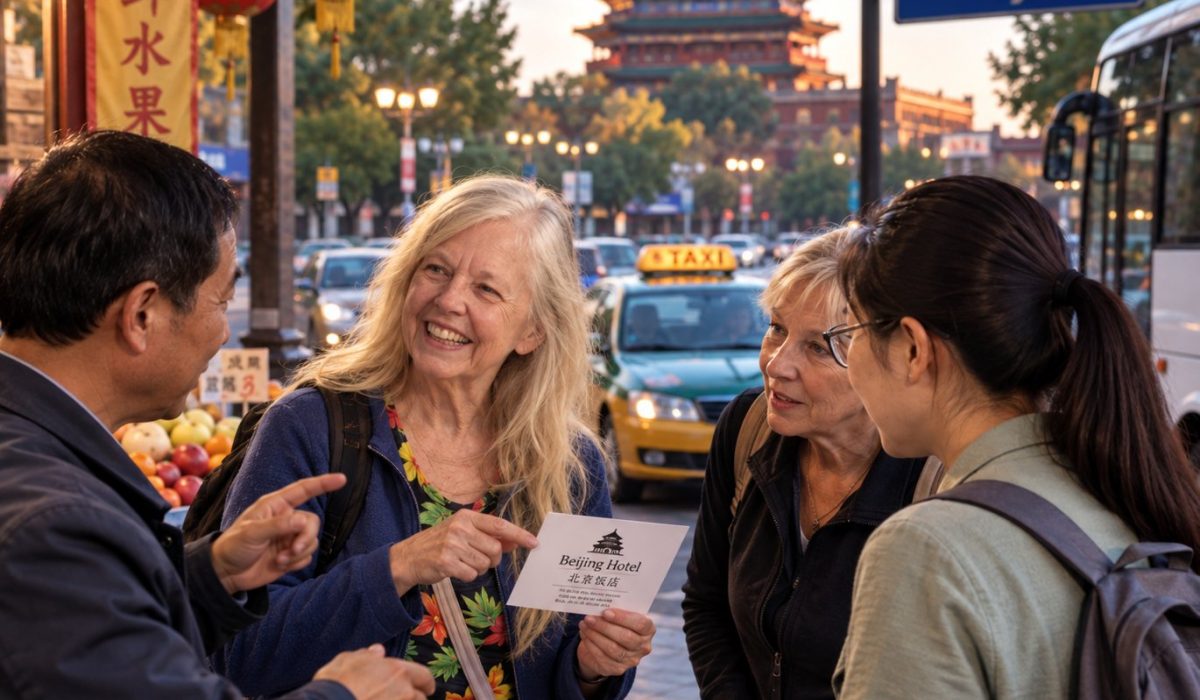
The driver at least knew enough to give them a card with the name and location of their hotel.
Then the bus left.
Theresa and Bobby were on their own.
They found what Theresa remembers as a little fruit stand on a corner and tried to communicate.
That didn't work very well.
There was pointing.
There were gestures.
There was presumably the international language of two Americans who desperately wanted someone to understand what they were trying to say.
Still no solution.
So Theresa looked around.
She noticed some people nearby who, as she remembers it, looked a little "preppy."
Maybe they spoke English.
There was only one way to find out.
Theresa walked over.
"Can you speak English?"
Some, they told her.
Good enough.
Theresa explained that she and her friend needed a taxi. They had the information for their hotel, but they needed someone to help them hail a cab and make sure they got where they were going.
Could they help?
Yes.
Problem solved.
They got the taxi.
They got back to the hotel.
And life went on.
Bobby apparently experienced Beijing somewhat differently.
She noticed the cameras.
There seemed to be cameras everywhere, and Bobby was conscious that people might be watching them.
Theresa wasn't.
Later, when they talked about it, Theresa said she hadn't noticed a single camera.
She hadn't been looking for them.
She had been looking for a bathroom, someone who spoke English, and a way back to the hotel.
That was enough.
Travel had been part of Theresa's life almost from the beginning.
Her parents took the family on long trips when she was growing up. They camped. They visited relatives. They went to the Oregon Coast, Death Valley, the Grand Canyon, Disneyland and Mexico.
Her parents were savers, which meant travel wasn't necessarily about spending freely. It was about figuring out how to make the trip work.
Theresa carried that habit into adulthood.
She watched travel offers. She subscribed to lists. She learned what trips ought to cost and waited for bargains.
That's how she says she found the China trip.
The price was almost unbelievable.
Three hundred dollars.
Theresa remembers that as covering transportation and the organized trip itself.
Some people might have looked at an offer like that and wondered what was wrong with it.
Theresa looked at it and wondered when she could go.
So she went.
There is something almost deceptively simple about the way Theresa tells these stories.
A problem appears.
She looks at it.
Then she starts looking for the way around it.
Sometimes the solution requires asking another person.
Sometimes it requires changing the plan.
Sometimes it means accepting that the thing she expected to do isn't going to happen and finding something else worth doing instead.
What she doesn't seem particularly interested in doing is spending much time worrying about the fact that the problem exists.
That evening in Beijing, she could have remained on the bus because getting off seemed too complicated.
She could have worried about missing the event.
She could have worried about being stranded in an enormous unfamiliar city.
She could have worried about not speaking the language.
Bobby could not wait.
So they got off.
Then they dealt with the next problem.
And then the next.
Years later, explaining the story, Theresa put her philosophy into words:
"In life for me, there's always a solution."
Then she went a little further.
"There really is not a no answer."
If the first person can't help, ask another.
If that doesn't work, ask someone else.
Keep looking.
Keep asking.
Eventually, Theresa believes, you'll find a way to get where you need to go.
The ten-year-old Theresa who stayed in her seat while someone else picked up the dollar might have found Beijing intimidating.
The adult Theresa didn't seem to think there was much to be intimidated by.
She had a hotel card.
She had a friend.
Somewhere in a city filled with millions of people, there had to be somebody who could speak enough English to help them find a taxi.
All she had to do was find that person.
So she did.
The evening performance went on without them.
Theresa doesn't seem particularly bothered by that.
Bobby got her bathroom.
They found their taxi.
They made it back to the hotel.
And Theresa had once again played the hand she had been dealt.
There was a problem.
Then there was a solution.
There almost always is.
To continue click on the words "THERESA THORSON" after the words "POSTED-IN"
Posted in theresa-thorson by Stories Worth Saving