
Coming Back
There had been a time when Theresa Thorson didn't need to look for something to do.
Work had taken care of that.
For years there had been young people to help, programs to run, staff to supervise, grants to pursue, problems to solve. Theresa had been good at that kind of life. She liked being useful, and she liked the feeling that came from taking something that wasn't working and figuring out how to make it work better.
Then she retired.
There had been good reasons for leaving work when she did. Ron was fourteen years older, and when he retired, Theresa decided she wanted time with him while they still had it. She was only about fifty when she walked away from a career that could easily have occupied her for many more years.
After Ron died, there was Richard. There were other interests, other relationships, travel and family.
Then Richard died too.
Theresa eventually found herself back in Redmond with something she had rarely possessed before.
Time.
At first, she didn't fill it particularly well.
She went to the Senior Center occasionally, but she wasn't deeply involved. She had gone there with her parents when visiting Redmond over the years. Her mother and father had been active at Zion Lutheran Church and involved with seniors in the community, so the place wasn't foreign to her. When Theresa visited, she might join whatever they were doing—play cards, dance, take part in an activity.
But it had been her parents' place.
Theresa had spent most of her adult life somewhere else.
When she returned to Redmond, she didn't immediately decide that the Senior Center would become hers.
She looked around.
She tried a few things.
And eventually she found the dancing.
That helped.
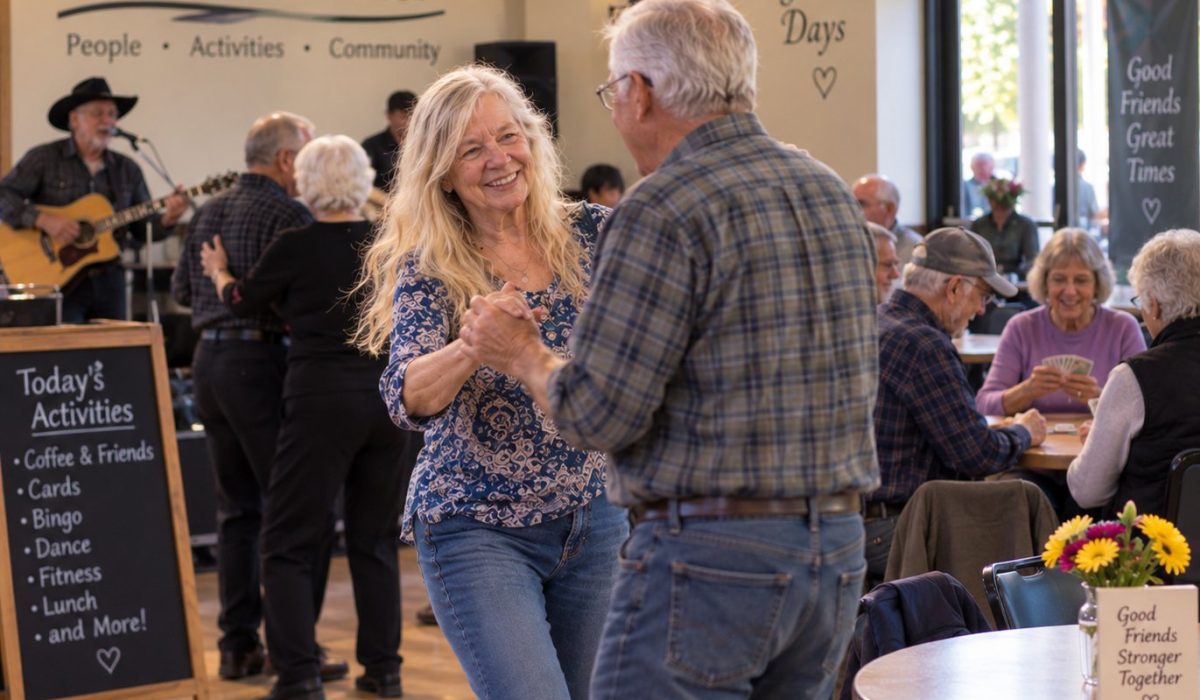
Theresa had always loved to dance. There were dances at the Senior Center, dances in Prineville, square dancing and other opportunities around Central Oregon. Dancing gave her somewhere to go and people to be around without requiring her to make some grand decision about what she was going to do with the rest of her life.
She could simply show up.
For a while, that was enough.
Then a woman came over to Theresa's table one day and suggested that she ought to join the Senior Center board.
Theresa knew exactly what she thought about that.
“I don't want to be on the board.”
The woman persisted. Theresa had good ideas, she told her. She could help.
Theresa remained reluctant.
“That's too much responsibility,” she said. “That's like work.”
She had already done work.
A great deal of it.
She had retired for a reason.
But Theresa also knew herself well enough to recognize another fact.
She wasn't doing much else.
Maybe, she thought, she could just be on the board.
Just help a little.
It was the sort of bargain people sometimes make with themselves shortly before discovering that they have misunderstood their own nature.
Theresa joined the board.
Then somebody left, and she became vice president.
About a year later, the president told Theresa that she needed to step away.
That left another question.
Did Theresa want to become president?
By then she knew enough about the organization to understand what the job would require. She also knew enough about herself to know what would happen if she accepted it.
She said yes anyway.
And the retired woman who had been reluctant to join the board because it sounded too much like work began running things much the way she had run programs throughout her professional life.
The setting had changed.
Theresa hadn't.
She started with people.
Organizations often complain that it is difficult to find volunteers. Theresa never found that particularly mysterious. She thought the problem was often that organizations began with the job that needed doing and then searched for a person willing to do it.
Theresa began with the person.
Spend some time with someone. Listen. Pay attention.
Maybe this person couldn't do one thing.
But perhaps there was something else she could do very well.
“You put them into a spot that they really shine in,” Theresa says. “You just don't put anybody into what you need.”
It was the same lesson she had learned years earlier with young people.
Don't begin with the label.
Don't begin with the slot you're trying to fill.
Begin with the person standing in front of you.
Figure out what that person can do.
Then give her a chance to do it.
Theresa encouraged people. She told them what they were doing right. She asked people to take on things they hadn't believed they could handle.
And people volunteered.
Lots of them.
The Senior Center needed more than volunteers.
It needed money.
Theresa looked at the board and realized that having good people wasn't enough. The organization also needed people who could reach beyond the lunch crowd, make connections in the community and help bring in financial support.
So she began recruiting those people too.
She didn't expect everyone to do the same job. Someone might be excellent at taking minutes. Someone else might be good at organizing. Another person might know people in the community who could help financially.
The important thing was putting the right person in the right place.
Slowly, things began to change.
The woman who once said she didn't want the responsibility of joining the board found herself carrying a remarkable amount of it.
Too much, eventually.
Theresa remained in the leadership role for about five years. In practice, she says, she became both board chair and the person running much of the organization.
And she did it without being paid.
Eventually even Theresa had to acknowledge what that was doing to her.
She was burned out.
So she did something that can be surprisingly difficult for people who are good at making themselves useful.
She stopped.
She told the woman who was serving as her vice president that she couldn't continue doing everything. Theresa was still willing to help. She could raise money occasionally. She could take responsibility for a particular project.
But she wasn't going to run the whole place anymore.
“I'm done.”
It wasn't an abandonment of the Senior Center.
It was a boundary.
And Theresa stayed.
Years later, you can still see the old program director in the way Theresa approaches things at the Senior Center.
Give her an activity and she starts thinking about how it can work better.
Give her a room full of people and she notices who needs help, who can handle responsibility and who might be good at something no one has asked them to do yet.
Give her a problem and, almost automatically, she begins looking for backups.
Not one backup.
Several.
Theresa doesn't like waiting for a problem to happen before wondering what to do about it. If someone can't be there, who else knows the job? If that person can't come either, who's next?
“What will happen if this happens?” she asks herself. “If this happens? If this happens?”
Then she prepares.
It is organization, certainly.
But Theresa thinks of it somewhat differently.
To her, that's how you create success.
There is a temptation to describe this period of Theresa's life as a return to work.
In some ways it was.
But something more important had returned with it.
Purpose.
After Richard's death, Theresa had spent too much time at home. Her world had narrowed. Alcohol had filled part of the empty space until it nearly destroyed her.
Recovery required Theresa to confront that.
But stopping drinking was not the same thing as building a life.
The Senior Center helped with the second part.
There were people again.
There were dances and cards and meals. There were projects that needed someone to organize them and people who needed encouragement. There were problems—always problems—and Theresa discovered that she still knew what to do with those.
She had spent her career helping young people prepare for the next place they were going.
Now, without quite intending to, she had found her own next place.
It wasn't a treatment program.
It wasn't a professional position.
Nobody had recruited Theresa because of a résumé.
A woman had simply walked over to her table and told her she had some good ideas.
Theresa had resisted.
She had already worked enough.
She didn't want the responsibility.
She didn't need another job.
But perhaps what she needed was something slightly different.
She needed somewhere for all that experience to go.
Somewhere to be useful again.
Somewhere to dance.
Somewhere to sit down at a table and discover that other people still needed things she knew how to give.
Theresa had come back to Redmond years earlier.
It took a little longer for Theresa to come back to herself.
To continue click on the words "THERESA THORSON" after the words "POSTED-IN"
Posted in theresa-thorson by Stories Worth Saving