
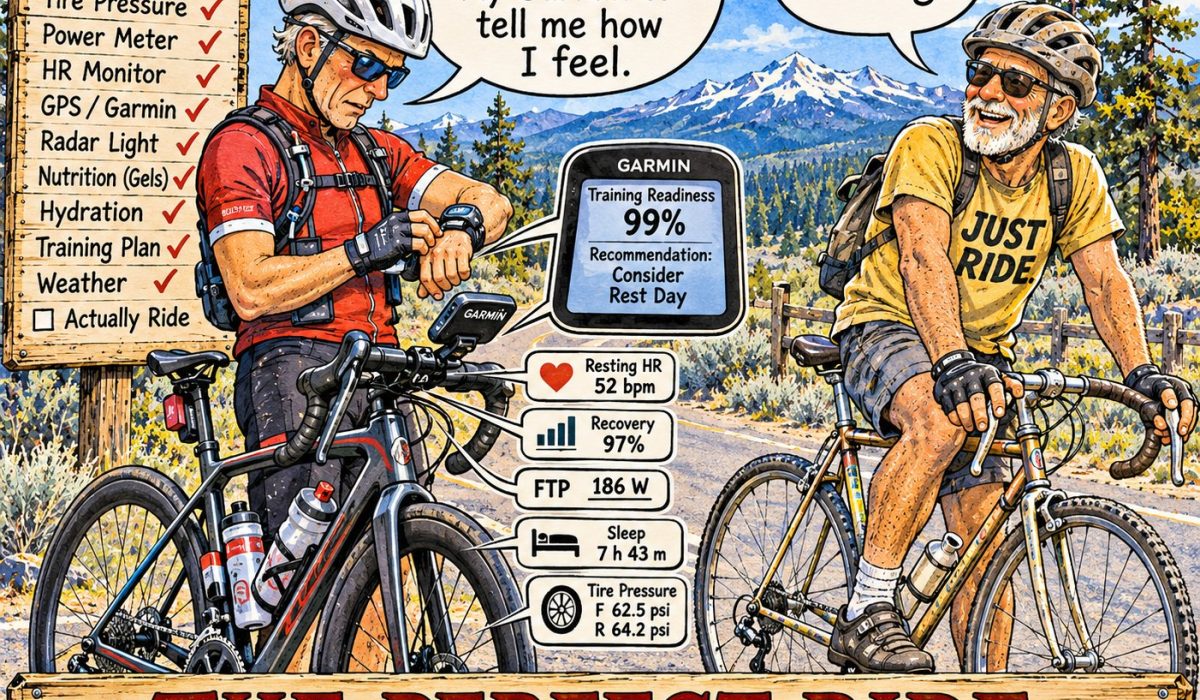
The Perfect Ride
The Perfect Ride
When cycling becomes a science, sometimes you forget to ride.
There was a time when going for a bicycle ride was a relatively simple undertaking.
You checked the tires, filled a water bottle, put on your helmet, and rode away.
Those days are gone.
For the modern amateur cyclist, preparing for a 35-mile ride now requires approximately the same level of planning as launching a small spacecraft.
Our cyclist had been awake since 5:30 a.m.
His first task was to check his Garmin training readiness score.
97%.
Excellent, but not perfect.
He briefly considered going back to bed.
Next came his resting heart rate, overnight HRV, sleep score, recovery time, and training load. His smartwatch reported that he'd slept seven hours and forty-three minutes, including an impressive amount of deep sleep.
Unfortunately, his recovery status was only Productive.
He preferred Peaking.
Breakfast required additional calculations. Forty grams of protein, sixty grams of carbohydrates, a carefully measured serving of oatmeal, and enough coffee to make the heart rate monitor question its calibration.
Then came the bicycle.
Tire pressure was checked to the nearest half PSI. The chain was lubricated. The power meter was calibrated. The electronic shifting battery was inspected, even though it had been charged the previous evening.
His Garmin Edge was fully charged.
His smartwatch was fully charged.
His radar taillight was fully charged.
His phone was fully charged.
He briefly wondered whether he was fully charged.
By 8:15, he was dressed and standing beside his bicycle.
The weather was perfect. Sunshine, light winds, and temperatures in the low sixties. The Cascade Mountains were magnificent against a cloudless blue sky.
It was going to be a wonderful ride.
But first, there were a few final preparations.
His Garmin couldn't find the heart rate sensor.
He adjusted the chest strap.
The Garmin found the sensor but wanted to calibrate the power meter.
He calibrated the power meter.
His smartwatch announced that his recovery score had dropped to 94%.
This was troubling.
He checked his phone.
Strava reported that a friend had just set a personal record on a nearby climb.
This was even more troubling.
He reconsidered the day's training plan.
Perhaps he should substitute intervals for the scheduled Zone 2 ride. After all, his FTP hadn't improved in three weeks.
Then he remembered that his training program specifically warned against unnecessary intensity.
He spent another five minutes contemplating the physiological consequences.
At 8:47, another cyclist appeared.
He was an older fellow riding a steel bicycle that looked as though it had been purchased sometime during the Reagan administration. His shorts were faded, his jersey didn't match, and his bicycle computer consisted of a small mechanical speedometer that hadn't worked in years.
He stopped beside our cyclist.
"Beautiful morning," he said.
"Perfect," our cyclist replied, studying his Garmin.
"You coming?"
"Almost ready. Just waiting for my Garmin to tell me how I feel."
The older fellow nodded thoughtfully.
"How do you feel?"
"Great."
"Well, there you go."
And with that, he pedaled away.
Our cyclist watched him disappear around the corner.
Then he looked down at his Garmin.
TRAINING READINESS: 99%.
RECOMMENDATION: CONSIDER REST DAY.
He stared at the screen.
For a moment, he considered following the recommendation.
Then something remarkable happened.
He pressed Start.
Put his phone away.
And began pedaling.
The first few miles were wonderful. The air was cool, the road was quiet, and the mountains looked exactly as they had before anyone invented a power meter.
He caught up with the older cyclist near the top of a gentle climb.
They rode together for several miles, talking about the weather, the countryside, and the pleasures of being outdoors.
Eventually, our cyclist glanced down at his Garmin.
His heart rate was slightly above Zone 2.
His power was below target.
His cadence was inconsistent.
His training load was increasing.
He looked over at his companion.
The older fellow was smiling.
And for the first time that morning, our cyclist realized something important.
He was having a wonderful ride.
Even though absolutely none of his numbers were perfect.
Of course, when he got home, he uploaded everything to Strava.
Some habits are simply too important to abandon.
The Perfect Ride
Thirty-five miles. Two cyclists. One beautiful morning.
And only one of them needed a satellite to enjoy it.
Posted in cycling-gallery by TFOL Gallery